
|
|
| Home > Floripedia > Emily Holder | |
Emily Holder
At the Dry Tortugas During the War1892
The following is an account written by Emily Holder describing her memories of Fort Jefferson. As the wife of the post surgeon during the turbulent 1860s, she led a very singular life on one of the most out-of-the-way places then imaginable. As the congenial wife of a prominent member of the fort's garrison (and one of the few women on the island), she had broad access to many areas around the fort. Beginning in January 1892, her journal was published in a series of installments of The Californian Illustrated. Reproduced here, they tell the poignant and often fascinating story of the hardships, isolation and drama of daily life at the Dry Tortugas in the nineteenth-century.
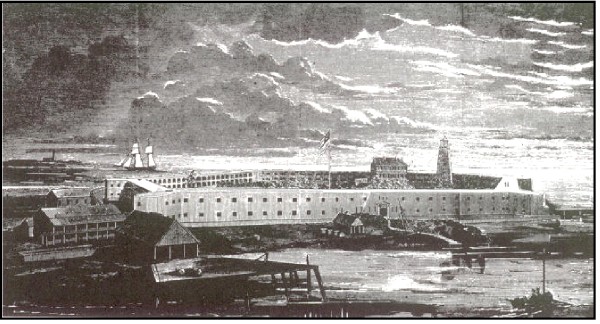
The great progress in modern scientific warfare within the last quarter of a century has made fort-building to our Engineer Corps a difficult problem. Discoveries in destructive power so keep pace with those of resistance that for humanity's sake we can but hope that the time may not be far distant when "They shall beat their swords into plowshares, and their spears into pruning-hooks; nation shall not lift up sword against nation, neither shall they learn war anymore," and that just and righteous arbitration will be method of tranquilizing all national disturbances.
Among our coast defenses thirty-five or forty years ago Key West and Tortugas, Florida, were considered stations of sufficient importance for the establishment of elaborate fortifications.
They were the extreme points reaching out toward the Spanish possessions. In any case they would be useful as depots of supply for our navy; and a fort on one of these keys farthest from the mainland would prevent its occupation by a foreign force.
About the year 1847 Fort Jefferson was commenced under the charge of Captain Wright of the United States Engineer Corps, and in 1859 had assumed a formidable appearance as it rose, apparently, directly from the sea to a height of nearly sixty feet, and after the towers at each bastion were completed presented a castellated and picturesque appearance.
This great work gave employment to some two or three hundred workmen, mostly slaves, whose masters lived in Key West, sixty miles away. So large a force naturally necessitated a resident physician. Doctor Whitehurst, who held the appointment for several years, resigned in the summer of this year.
Professor Agassiz had visited Tortugas the preceding winter, returning very enthusiastic over the coral and other marine forms; and those in authority had consented that the succeeding physician should be chosen with reference to biological science.
Professor Baird of the Smithsonian Institution knowing all this and also that my husband combined both qualities of surgeon and naturalist, it was through this influence that the position was tendered him and accepted in the autumn of 1859.
It seems strange to refer to letters that say the trip from New York to Washington was the most tiresome part of the journey, taking from six o'clock at night until six the next morning, with so many changes that the attempt to sleep was only an aggravation-when now the comforts and luxury in traveling simply depend upon the length of one's purse.
From there to Charleston the trip was slow but sure,-literally for the accommodation of every one. I remember the train stopping one day in the woods without any apparent cause. After a while people began to question the reason of the delay, when an old couple were seen coming through the woods putting on their wraps as they came. When they were assisted aboard, the train started on as leisurely as though time was of little value; we had evidently left hurry and bustle behind.
While in Charleston, although it impressed as having a general air of dilapidation,-its moldy walls, uneven sidewalks, and a want of thrift even in the better part of the city,-yet with it all we felt that the people found more enjoyment in life than we in the North with all our hurry and energy.
Taking the Isabel, the Havana steamer, we reached Key West in the evening a few days later, finding the mail schooner Tortugas waiting to convey us to Fort Jefferson, or Tortugas; so we saw nothing of the town, only as we steamed into the wharf; yet it gave us a most pleasant impression,-the lights glimmering through the cocoanut trees, the white sand, glimpses of the houses half hidden in the foliage, and the brilliant moonlight throwing a fairy-like glamor over all, making a picture never to be forgotten.
One night took us to Fort Jefferson, that in time became known as the famous Dry Tortugas; and our fist view in the early morning as we sailed in through the winding channel was surely suggestive of a prison. Over the top of the fort we caught sight of trees and the roof of a building with a tall, white lighthouse towering over all. The little keys that we had passed, some pure white, others with a few trees and shrubs, took away something of the isolated feeling.
Three miles away stretched out the largest of all these islands except the one on which the fort was built, on which was another larger lighthouse. The exterior of the fort was bare and repulsive, the interior offering a decided contrast.
Here were trees of the deep green belonging to tropical vegetation, so restful to the eye in the glaring sun; and as the walls inclosed about thirteen acres, and water could not be seen, I instinctively lost the feeling of being so far from the mainland.
The walk, hard as cement and white as snow, partly shaded by the evergreen trees, led past the lighthouse and cottage of the keeper to the opposite side of the fort, where we were taken into a large, cool and pleasant house, and given a warm welcome by Captain Woodbury and his charming wife and family, who soon made us feel that a home does not depend upon locality, but in the hearts of the people.
It had been very difficult in our hurried departure from home to learn just what was necessary for living in such an out-of-the-way place; and, as we only looked forward to a stay of one winter, we took nothing for housekeeping purposes, thinking that we should probably board at some hotel perhaps-suggestive of the idea we had of the Dry Tortugas.
We soon concluded that, however primitive it might be, a home of our own would be preferable, so went shopping at the one store outside the walls. The winds had blown up sand until there was an acre perhaps stretched along the moat outside the seawall; and on this atom of land was the store, mess-hall for the workmen, carpenter-shop and a long building where the men slept, and further along the edge of the sand stood the Engineer Hospital, where it was always cool and breezy.
The store was for the accommodation of the men, and contained a medley of things. Here we bought a stove and enough of the necessities to start our primitive housekeeping.
We had some tables made by the island carpenter, a bedstead, also a rocking-chair, that must be in existence now judging from its strength and durability. There was always a mystery about its rocking power, which my kindly feeling for the carpenter prevented questioning. It was not a frisky piece of furniture that made one feel in danger of tipping over, but tall, staid and dignified, requiring some effort to tilt it. The length of the rockers suggested the long swing of a hammock, so that one started off with anticipation of a restful enjoyment; but these anticipations were soon dispelled by its little tilt forward and very sudden termination of the backward swing, causing the occupant to look around for the obstruction, when, seeing nothing, the impetus would be given again with a little more energy. After several such unsuccessful attempts we came to the conclusion that it was its own peculiar way of rocking; and the mystery was never solved why such a wonderful length of rockers produced so few rocks; but we managed to obtained unqualified comfort from it, and some quiet amusement when strangers attempted it.
We finally began housekeeping with an old colored woman as cook and a boy as waiter. The former was a character, a slave of a Mrs. Fogarty, who kept the mess-hall and who loaned her to me until my cook, a certain Aunt Rachel, could come from her master at Key West.
The latter was evidently held in great veneration by the colored people; and I was considered very fortunate in securing her. She was a famous cook and the wife of Bill King, the cook of the schooner Tortugas.
Aunt Eliza was so black that in the dark I could see nothing but the whites of her eyes, under a huge yellow turban from which two little black braids the size of pipestems stood at right angles behind each ear, from which hung enormous gilt hoops. Her front teeth had long since disappeared; and I found that the strong odor of a pipe, which, she said, came from Jack's smoking in the kitchen, was from her own, which I found in all sorts of improper and inconceivable places.
She stooped so that I asked her the cause when she replied: 'Why, honey, dat's from workin' in de cotton field. I'se so ugly dey couldn't keep me in de house; and after Mr. Phillips (the overseer) bought my gal Clarssy I dun took on so, and was dat bad, my master glad nuf to sell me down yer."
But I said where was your husband? "Oh, I lef him and got Jack." Jack was a good-looking colored boy about thirty, while she confessed to fifty. He was one of the workmen owned in Key West, and lived with Aunt Eliza over our kitchen, which was a separate house with a chamber over in the rear of the larger one. She showed none of her ugliness to me, but one day I heard on outcry and ran to the dining-room window just in time to see Jack flying out of the back gate, with Aunt Eliza in close pursuit swinging an axe, threatening to "split his head open if he ever came there again."
I called her in to remonstrate, and at first she said she really meant it, but after awhile confessed she did it to frighten him, as he was so lazy he would not wait upon her. "I'se boss, Missus," was her explanation.
For several days she had supreme control of the kitchen, with little Lewis, and smoked her pipe in peace; then she asked me if Jack might come back; she was lonesome. I consented upon the condition that if there were any more disturbances he must stay away entirely.
She evidently wanted to please, and was anxious to remain in my service; yet without being openly disloyal to Aunt Rachel, she never lost an opportunity to give a good reason for her delay in coming.
The fort on the inside showed long stretches on each curtain of arches, making pleasant places for walking, cool and shady; and in the moonlight the effect was really beautiful. Looking not unlike some grand old ruin with its lights and shadows, one could invest it with all sorts of romance. Cooper laid the scene of "Jack Tier" here, in a cottage by the lighthouse which had given place to the one now standing.
The seawall around the moat was our favorite walk, making nearly a mile. The atmosphere was so clear that the space between the sky and the earth seemed interminable. The sun was dazzling in its brightness.
The wind coming in through the embrasures kept the shiny leaves of the mangrove constantly quivering; and the rattling among the cocoanut branches sounded not unlike gentle rain. Outside the deep blue water was covered with whitecaps, which broke into waves wherever the coral approached the surface.
Such was our winter weather, except when a norther came scurrying over the gulf; then, as the children say, we played that it was cold, and built a fire in one of the big fireplaces, listened to the wind blowing the sand against the windows, and said, "Doesn't that sound like snow?"
The northers lasted three or four days; then we would have another two or three weeks of lovely summer days again, and my husband would spend part of each day collecting specimens. He had built on the water's edge a little house with a wall extending fifteen feet square out into the water, so that it flowed in and out through the interstices; and here he kept all kinds of specimens and watched their growth and development.
It was most interesting even to those who did not claim to be naturalists; and, as all our outside pleasures were necessarily aquatic, one learned without an effort from the familiarity of natural objects; and as our resources were necessarily limited we took advantage of everything that presented itself, and so found amusement and entertainment.
On Sundays Captain Woodbury; who with his family were Episcopalians, read the lessons and afterwards a sermon. Mrs. Woodbury had organized a choir, some among the white workmen, in fact any one who could sing; and everybody was invited to attend the service; oftentimes filling the large parlor.
Rowing and trips to the adjacent keys for shells, especially after a norther, were our frequent pastimes.
The water was so clear we could distinguish objects clearly at the depths of sixty feet; and it was like rowing over a garden when it was calm, to drift along watching the fish darting in and out among the huge heads of coral, and sea-fans that gently waved back and forth in the current.
Often there would be large schools of harmless sharks close in shore. As there were acres of shoal water only a few feet deep, where all this could be seen, and as there were always boats ready we went rowing or sailing as the people on the mainland went to drive.
The event of this first winter was a visit to Key West, which, in its palmiest days, was a lovely place with charming society, though the war cloud changed it utterly and hopelessly later on.
We arrived at night, going to the hotel, but before breakfast the next morning, Captain Curtis, to whom we had letters of introduction, came and took us to his lovely home sheltered in a grove of cocoanut trees. It seemed a bit of fairy land, so purely tropical was it with all the luxury and taste of a Northern home. I shall never forget the first impression it made upon me.
We were given the quaintest, cosiest little house they called the cabin to sleep in; it was in the yard, embowered in trees and flowering shrubs, and was really a ship's cabin taken from a wreck, brought there and arranged as a guest-room, or two rooms rather, and a dressing room, with a little piazza in front. The very romance of the surroundings kept me awake listening to the gentle sound of the wind among the trees, when to add to all this we were suddenly roused by a serenade of stringed instruments, sweet and soft, carrying out the fairy idea of it all.
The next day we dined at Fort Taylor, meeting Captain Hunt and Professor Trowbridge. The former was the engineer in charge,--a most agreeable gentleman, full of life and good humor. His wife, who after his sad death became the famous author "H.H.," was in the North. I remember Captain Hunt took us to ride in a huge carriage drawn by a very small mule that was wise enough to understand that, when the whip dropped through the drawbridge, he was master of the situation; and nothing short of the prods of the Captain's umbrella, after a cane had been sacrificed, would arouse him to a sense of duty; but he carried us safely to all the points of interest.
The following night a party was given us at the fort, where we met many delightful people,-Judge Marvin, Judge Douglass, the officers of the steamship Corwin, and a number who were to leave the next day; and as Captain Hunt was to return with us on a visit at Captain Woodbury's, and Judge Douglass and Professor Trowbridge were going to Havana, we were invited to go down on the steamer Corwin with them.
My memories of Key West, as it was then, are delightful, standing out clear and bright; every one was happy and contented in their island home.
So many names come into my mind as I write;-Mr. Herrick, the rector and his hospitable wife, the Bethels, the Browns, who had the most beautiful house on the island, and many others who showed us many kinds of attentions.
Judge Douglass was an inimitable story-teller; and it was a merry party that reluctantly separated at eleven, when the steamer reached the entrance of Tortugas harbor on the return, sending us ashore in a cutter in charge of an officer, a son of Bishop Odenhemier of New Jersey.
Captain Hunt remained a week, and Mrs. Woodbury gave a dinner party for him; and, finally, two days before he left, I extended the same hospitality, wondering if he would notice the similarity in china and table equipment, for our "things" were yet en route; even the chairs had not reached Key West.
Calling in Sophy Benners, the chief cook of the island, who belonged to the lighthouse keeper, and deposing old Eliza, who looked rather mournful over the downfall, we planned a dinner that must have been a surprise; there were fruits and flowers and borrowed china, even to the chairs, which I feared encountered the guests going into the back door as they entered the front, as the hall passed through from front to rear.
My guests were kind enough to pronounce the dinner a success, and I enjoyed the novelty of the whole thing extremely, perhaps more than I should if my ingenuity had been less taxed.
A few days later Sophy Benners (for the slaves all took the name of their masters) and Peter Philor proposed entering the married state with more than ordinary pomp and splendor. The master, Mr. Philor, lived in Key West, owning a large number of slaves who worked on the fort, there being four Johns alone, the last one always giving his name as "John de fofe, sah" in answer to the overseer's call.
Peter had obtained permission from his master to marry Sophy, and so came to Captain Woodbury to ask if he would marry them. The latter replied, "Certainly, where are you going to be married?"
"In your parlor, sah.," said Peter. And we heard that Sophy had given out invitations to this effect:
"Sophy will be agreeable to her friends at seben o'clock in Captain Woodbury's parlor; after dat comes de ball."
Aunt Eliza soon came up to tell me what was going to happen, and I asked her if she was going to the ball.
"Sartinly, ma'am, and I must go and wash my skin, now I'se got de kettle on."
The wedding was affair to be remembered. All the white people assembeled in the front parlor; and at the supreme moment the folding doors were thrown open, and the bridal party came forward: two bridesmaids all in white, and two groomsmen. The bride wore a white veil with flowers; and she married with a ring, her mistress giving her away (in theory only).
The boys (all black men were called boys) had had their hair braided for a week; and some of their heads were large enough to fill a bushel basket.
After the couple were pronounced man and wife they adjourned to the mess-hall, the guests following in about an hour, as every one had been formally invited.
We saw them dance a while; then they passed us cake and wine, and we started to go home, when some one said we ought to stay and see Aunt Eliza dance a jig; and to my amazement my old cook with a young man took the floor. She looked rather shy, saying, "de Lor', I cyant dance;" but the music soon took possession of her poor old feet, and she gradually straightened up, swaying back and forth with the music, evidently forgetting everything else. She danced away I could scarcely believe that the jubilant figure was the old slave that groaned and grumbled about the little work demanded of her. She outdanced the boy and left him far behind. They are as a race music-loving; and I saw in a dark corner of the ballroom my incorrigible servant Lewis dancing all by himself happy as a king.
We learned that the colored people knew old Eliza's gift and had coaxed her to come and dance a jig, with the promise that one of the boys should do all her scrubbing on Friday; and we certainly came near being flooded the following day. He was as good as his word, as the house shone from top to bottom.
Old Eliza was such a character I cannot refrain from recounting some of her amusing, yet at the same time rather perplexing, acts.
The dignity of the cook was not easily adjusted, and rather overpowering, but she improved as time went on. In the early days of her new position, installed in a house the same as the cook of the commanding officer, she felt her importance and showed it, not unlike wiser and older people. Such differences vary only in degree; and in her case it was very amusing.
Fresh beef was a luxury only indulged in occasionally; but turtles were kept in the moat and killed whenever we wanted them.
As I was not accustomed to the methods of preparation in vogue on the reef, and not wishing to unnecessarily expose my ignorance, I concluded "that discretion was the better part of valor," and pretended to be very busy in the house, so that on those days Eliza was mistress of the kitchen.
The first time she prepared green turtle a very fine soup was served, followed by what she called turtle balls.
After dinner Eliza asked me how I liked it.
I replied very much, only the next time we would try it without onions.
They had brought me a quantity and I had told her to partly cook what was left, to be sure that it would keep.
The following afternoon she came upstairs and said, "What shall we hab for dinner, Missis?"
"Why, the turtle balls that were left yesterday," I replied, "and whatever vegetables we can get, with a pineapple tart."
She looked at me with a queer expression, finally bursting into an embarrassed laugh, and said, "De Lor', de Lor', how funny. Yo' 'spect to hab dem balls for dinner, and I and Jack and Lewis dun eat 'em all up las' night. De Lor', de Lor', I eat five, like to kill me, and Jack say he neber eat sech balls on dis yer key fore."
"But," I said, "you told me you did not like them, never ate them, and I gave you bacon for your dinner."
I suppose she saw a look of dismay on my face, for she stopped laughing and said:
"I'se sorry, Missis; I tout you didn't like 'em wid de onions, so we dun eat um. De Lor', want dey good."
"Well," I said, as a dinner without meat seemed to be the prospect, "make an ochre soup and we will do without fresh meat to-day," and she left me, as I thought, with rather a woebegone expression.
When the soup was served at dinner, the ochre was certainly not in sufficient quantity to warrant its name, and I said, "Why didn't you put in more ochre?"
"Why," she replied, with a toss of her head that endangered the foundation of the yellow turban, "want time, Missis, want time, guess ise made soup afore."
"But ," I said, "it would not take any longer to cook all you had than a few."
Seeing there was no help for it, the confession very awkwardly followed, that they had eaten the ochres too.
I then learned that I must treat her like a child, giving her what she was to have, and telling her what to serve us.
I had learned that planning one's meals at the Dry Tortugas depended, in a great measure, upon one's wits and ingenuity.
The plan was to bring us fresh beef from the mainland once a month; but the best of intentions fail sometimes and our supply was no exception to that rule.
Time sped very rapidly notwithstanding our necessarily monotonous life, the greatest events of interest consisting of our mails; and the delight with which we hailed the sight of the mail schooner Tortugas over the top of the fort when we looked out in the morning never abated.
No orders of removal had yet arrived for Captain Woodbury, although they had spent four years there, so they decided to go North for the summer.
Our intercourse had been so delightful that the prospect of living there without them was appalling; for my husband had become so interested in his scientific labors he had planned to remain another year. Our household goods had arrived from the North some time before, so that the home began to look cheerful; yet Mrs. Woodbury's piano and large family nearly always attracted us there in the evenings.
The mornings were devoted to lessons for the young folks, but the afternoons invariably found us on the water or wandering over some of the adjacent keys, where the boys became apt pupils in the study of natural objects.
Our evenings after the little folks were asleep we spent together, reading aloud or with music and conversation; and the peaceful, happy life we led I think was often, by all of us, looked back in the sorrowful years that followed, if not with longing, with great pleasure.
They were sad days before and after Captain Woodbury's family left, for it took some time to adjust ourselves to the loneliness that followed; and I never shall forget the peculiar sensation with which I watched the schooner Tortugas float away with them all one bright moonlight night, leaving us almost alone upon this sand bank on the borders of the great Gulf Stream. The Fourth of July of 1860 passed very quietly. Our greatest annoyances now were the delay of the mails and the scarcity of good things to eat. We wearied of canned food, and pined for fresh vegetables that were not. Even green grass to look at was a premium. Green turtles and fish we had in abundance, and, occasionally, a pig was killed; but we longed for more variety. The fowls were poor from not having the proper food, and coral sand did not answer as a substitute for gravel. We sent to Key West, sixty miles away, for any and all kinds of vegetables that Captain Wilson could find; but he returned with the word that there was nothing in Key West but a few onions, which were quoted at one dollar per small bunch.
We had excellent rainwater to drink, caught during the rainy season in large reservoirs. Ice was an unknown quantity on the Key and twenty cents a pound in Key West. If we had ordered it, and there had not been a stiff breeze, it would simply have resulted in our providing the boat's crew with ice water, and having the pleasure of paying for it; so we kept our drinking-water in porous jars called monkeys, which hung in the shade, keeping it sufficiently cool. The butter would have been benefited by ice if we could have kept it all the time, but to be frozen one day and dealt out with a spoon the next day would, in all probability, have had a bad effect upon it; so we kept it in as cool a place as we could find, and it was test of the temperature whether a knife or a spoon was placed by the side of the butter dish. It was usually a feast or a famine, and just at that date the latter state seemed to prevail.
The flour grew poor; the weevils shared it with us; we could see them flying in the air near the casemate where a quantity of flour was stored. We grew hungry for even some of the lean things of the land; but we did not lose our spirits or cheerfulness. The first of August a steamer arrived with our own private stores of canned fruits and vegetables from New York, and, better yet, with news of an appropriation for the forts, which meant more comforts in the way of livestock and new life generally.
The mail boat brought us bananas, fresh beans and, best of all, a box of good things from home; and to say that we were excited and happy rather proved that we were previously in much the same state Aunt Eliza complained of when I tried to hurry her,-"stagnated."
During August and September we had a succession of fearful thunderstorms that frightened me more than I cared to admit. They continued for nine days in succession. Even the old fishermen acknowledged them to be unusually severe. The thunder echoed and reverberated through the arches so that it seemed as though the whole fort was going to tumble down about our heads.
The heat was intense, and the mosquitoes distracting. As the Tortugas brought no mail, a month without letters was almost as trying as going without food. August found us in low spirits.
Finally the transport arrived; bringing us fresh beef, the first we had seen in four months; and, having some onions and potatoes, we feasted. The great delay was thus explained by Captain Wilson: he had purchased some fresh meat for the fort, and was all ready to sail when a squall came up without warning; and he was obliged to take it back to the butcher's ice-box and wait for the gale to subside. When it had spent itself he made another purchase; but the elements were in a capricious mood, and, fearing a calm would be as disastrous to his cargo as a gale, he again appealed to the butcher, who this time refused to take it back, and it was packed in ice, we reaping the benefit.
Aunt Eliza often spoke of "broiling her brains it was so hot." I now felt that it might almost be possible.
The rainstorms continued up to October, but more gently; yet to the north of us a number of wrecks were reported.
It did not take much to rouse the residents of the island to a state of excitement; and when the Tortugas came back one morning, after having started for Key West, with a deserted wreck in tow, a crowd soon assembled.
It was a sad sight. Both masts were gone, and there was a great hole in the side which had been stopped with the bedding. The rudder was gone, but they had made a temporary one which suggested that the crew had survived the worst of the gale and been taken off, which was the case, as we heard that a vessel from New Orleans, bound for Liverpool, picked them up and landed them in Havana.
There were fifteen on board the hapless craft, some women and children. The vessel was from Trinidad, bound for Cuba, loaded with fruits in glass jars, and wines, which were afterwards sold in Key West. Several dismantled vessels went into Key West that could not make our harbor. One that was spoken was out of water and provisions. They hoped to make Key West, but, as they did not, it was feared the vessel went down. The gales at that season were to be dreaded as there was so little warning; and yet they did not call them hurricanes, which they were to all intents and purposes. Even Aunt Eliza began to tire of the Dry Tortugas.
She was evidently in a "low-down state," as she announced one day that she was, "De only one lef' of all her fambly."
Thinking she had heard some bad news, I asked, "Where are your brothers?"
"Oh," she replied, "dey is in Sabanna, but dey might as well be dead; I neber see um 'gin," and she would "not las' long herself. De rheumatiz got above my knees now." Then she would take her pipe and smoke until she was dizzy.
About the middle of October we had our first norther. The mercury fell from eighty-five to seventy-five degrees; and we all took heart as we inhaled the cool air.
Just before the norther a vessel drifted upon the reef off Loggerhead. Had the norther held off a few hours even, she might have been floated, as the wrecking-smacks were trying to lighten her; but there was no hope after that. She was driven up where the sharp coral crushed a hole in her; and the water was soon even outside and in.
There was rumor that the vessel was allowed to float upon the reef, which would account for the wreckers being so promptly on hand. Such things had been done; but no one felt positive enough to make such an assertion openly.
I was glad to have the hurricane season pass without a genuine one. As an example of the suddenness of the squalls, one day while we were at the dinner-table it grew suddenly dark; we rose, walked through the hall to look at the clouds, and before we could return to the foot of the stairs, half way from the front door, the squall struck the island with such violence that a chair, standing before a long window on the second floor, was blown across the room and a hall and half way down the stairs, and the rooms flooded with water, while it grew so dark that we had to light the lamps. No wonder we were glad to have the season for such performances over.
The irregularity of the mail was exasperating, as it was our only connection with the outer world; and to wait three weeks again for a letter or any news from the North made us almost desperate.
The last detention was caused by a disabled steamer at the mouth of the Mississippi River; for our mails came in various ways, there being no regular mail contact for Key West. The railroad was under water up the coast, so the mail was sent to Mobile to reach the New Orleans steamer. The schooner Tortugas waited a week for the mail, then started to come down without it, but sighting the steamer returned, even then being becalmed twenty-four hours in sight of Key West.
A rumor now reached us that Captain Woodbury was coming with Captain Meigs* by the next boat, which meant a change in the command.
We watched most anxiously for the boat, spending the afternoon on the ramparts with the glass; but the horizon showed nothing that came out of the regular course to New Orleans until nearly night, when we discovered the black topmasts of what we thought was the Tortugas; but it was so calm there was no hope of her reaching us for hours.
We could see the wreck away on the other side of the fort with its fleet of schooners looking like a harbor in the midst of the sea; but the darkness came on with the Tortugas scarcely any nearer. At ten o'clock there was no word, and by midnight we gave it up and went to bed, to be awakened by the watchman calling to the clerk of the office that mail was in. Of course sleep was out of the question until I knew of the arrivals, and how I should manage if the guests had arrived.
Captain Wilson had been ordered to have the flag at the peak if strangers were on board, but in the darkness we could not see. After a while one pair of feet only came into our hall; and we soon heard that there was no mail, that Captains Woodbury and Meigs would come on the next boat, also that the mail contract had been given to the Isabel, and that hereafter we could look forward to a regularity in the arrivals,-a great relief.
Disturbing political rumors that for the past six weeks had been in the air without giving us any special uneasiness seemed to increase; yet we gave them little thought, considering them as evidences of a strong party feeling, perhaps increased by the nomination and election of Lincoln.
Being surrounded by people of Southern sympathies, we heard little except their side of the question, and the one of appropriation for the forts. The latter was an all-important one to them, as, if it failed, there would be hundreds of slaves without employment,-a serious matter to slave-owners who had to feed and clothe them.
The next boat brought Captain Woodbury, Captain Meigs, his clerk, Dr. Gowland, and Mr. Howells as draughtsman.
Captain Meigs accompanied him to Key West, returning by the next boat, which also brought a friend and her maid, to make me a long-promised visit, and my husband's brother,-the letter a most delightful surprise. My new cook proved a treasure; and all this made quite a revolution, and for a few weeks I felt that civilization had overtaken us. My guest brought her beds for herself and her maid, needing them on the boat; so that they were provided for.
We enjoyed the bustle and commotion of people about us, and the return to some of the conventionalities of life, which so much time spent upon the water had interfered with. To add to the life infused by all this, a man-of-war, the Mohawk, Captain Craven,* came into the harbor. The following day I gave a dinner party of twelve covers to Captain Craven and his officers. With a market sixty miles away, one's wits did extra duty. But the dinner was apparently a success, if one could judge by the appearance of the guests; and to us, who had been so long deprived of society, it was a delightful occasion. The next day the gentlemen took the Tortugas and went fishing, and the following week was a gay one for all.
Threatening news came by the next boat. Sometimes when we heard Captains Meigs and Craven, who were so recently from the active world, discussing the state of feeling in the South, it made us a little apprehensive, but that soon passed away. The idea of a civil war seemed impossible.
A few weeks later it became so desolate at Tortugas that I accepted an invitation to visit Key West.
The climate here was perfection at that season of the year, with much less wind than we had at Tortugas; and it was a delight to go about the streets, into real stores, and to visit people after our seclusion for so many months.
During my visit Captain Craven arrived with two slave ships, captured off Havana, that had just started for Africa.
The following day came the election for candidates to attend the Secession Convention held in Tallahassee. The secessionists were victorious, and announced boldly that they would take Fort Taylor at Key West.
Rumor also said there was no money in the State treasury; that the Governor had taken it to send North for ammunition.
A rather decided secessionist told Captain Brannon, who was in command of the fort, that they would starve them out. His reply was that he could drop a ball into his house that would bring out all the provisions they wanted.
I wondered at the good feeling where so much spirit was displayed, and tried not to be drawn into any discussion, as I could not believe there would be anything more than a war of words.
The day before Christmas Mr. Philor placed his carriage at our service, and we drove to some gardens where all the trees and shrubs were new to us, a perfect tangle of tropical growth, even to a Banyan tree. Then we drove to the fort, which was the end of the drive in that direction, and to the barracoons where the slaves were kept until they could be sent to Africa. Those here were taken by the U. S. S. Powhatan some months before. It was a sorrowful sight, and brought home the horrors of slavery more intensely than anything I had ever seen before.
Christmas was more like a Northern fourth of July in temperature and noise. We attended service in the morning, met numbers of our friends, and spent a most delightful day; and at night some of the officers of the Mohawk gave us a serenade that made a delightful ending to the holiday.
Captain Meigs stopped on his return from a trip to Havana, bringing the news of the secession of South Carolina, Captain Hunt joining him to talk over the outlook. It began to look cloudy at least; yet no one thought there would be a civil war.
The next Sunday a proclamation from the President was read in church "of a day for fasting and prayer" on account of national trouble and the prospect of a civil war.
The few remaining days of our visit were spent in returning the calls of the many pleasant people who had entertained us. There were so many delightful and homes it was sad to think what might result from the feeling that would show itself in spite of all courtesy.
Captain Meigs and my husband talked of a trip to Tampa, after which we were to return to Tortugas, as we had already remained away longer than we intended.
On January 1, 1861, a rumor came that Mordaci, the owner of the Isabel, had offered her to Carolina for a man-of-war, our mail contract going with her.
There was a cloud on the horizon that looked larger than a man's hand, and it affected our spirits. People began to be suspicious of their neighbors. Those who claimed to be Northern sympathizers owned their servants. There were many Southerners in Key West; but a goodly number were originally from the North, who, dwelling many years in that climate, and owning simply their house servants, were doubtful whether, if Florida seceded, they ought not stand by the State of their adoption. The Northern residents who did not own slaves were true Unionists from the first. The slave seemed to be the turning point. The Conchs, as people from Bahama were called, were boisterous in their demonstrations of loyalty to the South; but, at the first suggestion of their doing duty in case of necessity, they packed their goods and sailed for the British Isles.
One morning the first news that greeted the gentlemen on the street was that the militia of the town had attempted to take Fort Taylor during the night. A futile effort, however, as Captain Brannon had sent the two companies of regulars from the barracks the night before after dark, leaving the harmless gun carriages covered, so that no one suspected the removal of the guns. Captain Hunt had turned the workmen into soldiers, and they had been employed all the previous day in taking the wharf away and every available means of entrance; so that an unexpected bath would have been the result of the attempt to gain entrance over the planks innocently leading to the open spaces.
A great state of excitement now prevailed. Letters that were sent to Washington were opened and destroyed; and our own from the North were delayed purposely, and sometimes not forwarded from Charleston, so that we began sending our mails north via Havana.
I was beginning to weary of the very name of secession; for there was little else discussed, and it made us gloomy if we allowed ourselves to dwell upon the outlook, although no one yet admitted that there was to be a war.
Affairs began to assume such a serious aspect that Captains Meigs, Hunt and Brannon held a council on board the Mohawk, resulting in our leaving for Tortugas the next day. Captain Maffitt met with the officers, but he resigned the next morning, leaving his ship there; he afterwards commanded the Confederate privateer Florida.
There were joking remarks made by our friends that if we found the fort in possession of the secessionists we could return,-not in the least cheering to us, although we treated them with as much levity as they did; but I think when we were near enough to our little island home to discern with a glass that the flag that floated over it was the stars and strips it was a greater relief than, perhaps, any of us wanted to acknowledge.
Our defenseless situation was almost an invitation to the enemy to capture us; and why they did not was rather a mystery to us. The WyandottZÿ, we heard, was on the way to take possession of both forts, and could have taken Fort Jefferson simply by steaming in and claiming it; for there was not a single gun on the island.
Active work began on our return. A drawbridge was made and raised every night, all communication with the outside being cut off.
The evening of the seventeenth of January Captain Meigs called, and I remember his reading Shakespeare aloud, and discussing some of the historical plays with my husband. They were both students of Shakespeare. In the midst of it Mr. Howells came in saying that the sheriff had arrived from Key West to arrest the fishermen, and they had sent for Captain Meigs to intercede for them.
The facts of the case were that the State of Florida had made a new law that none of the fishermen could obtain a clearance to go to Havana without paying a fine or license of two of three hundred dollars. Of course they could not pay it; and the object was to drive them home. They were mostly from Connecticut; and there were fourteen smacks in the harbor. They came down every winter to fish, taking their catch to Havana market.
Captain Meigs sent word to them not to pay it, and to the sheriff that he was Governor of that island, and he had better return to Key West. Then he sent Mr. Howells off privately that night to Key West for guns. He felt it was time to take the responsibility, even if he was censured for it.
I asked if he apprehended any danger. He looked at me as though he were thinking whether it was best to alarm me, and said: "No, Madam, but I want to be prepared in case of emergency. If we had a few guns we should not be molested. Guns are not so much to use as to keep people away."
He was the man for an emergency; and I think General Scott, instead of censuring him, praised his prompt action fully.
The following morning, January 18, 1861, our excitement culminated in the news that a man-of-war was in sight and steaming up the harbor. Every one was wild with excitement, running to the bastion with glasses to see what flag she floated; yet even that might have been a deception if it proved to be the red, white and blue. But she carried no flag, a fact we considered suspicious.
Captain Meigs sent Dr. Gowland to meet them as they stopped outside the reef, sending a boat ashore in a spot known to us as very dangerous, unless the navigators knew the channel exactly. It was a narrow opening in the reef, called the "five-foot channel," and only used by our small sail-boats. Dr. Gowland carried orders, that if they were enemies they could not land. A verbal resistance was the only one he could offer, but as soon as the two boats met a signal was given to those on board the steamer, and the stars and striped flew to the masthead. The feeling of those who were watching from the fort can better imagined than described; and none of us realized the tension we had been under until this relief came.
It proved to be the steamer Joseph Whitney, with Major Arnold in command, from Fort Independence, at Boston, with troops for our relief.
The reception they received must have left no doubts in their minds regarding their welcome. We were more than overjoyed; and the commotion and excitement of unloading the steamer, for she was to return immediately, as her expense to the Government was six hundred dollars a day, was something that tested the ability of every one. It did not take long to put us in a state of defense and everything in military order. We were now aroused at sunrise by the reveille. A sentinel walked in front of the guardhouse, at the drawbridge, and one was posted in the lighthouse tower.
Already our quiet life was a thing of the past. The large guns came from Key West, were soon mounted, and we began to feel as though we were on a war footing. Yet with all this Major Arnold did not think there would be war, and we surely hoped not. The New Orleans boat was taken off, and our only method of sending and receiving mail was through Havana, where the schooner Tortugas was sent for it.
The papers now received were old, but did duty all over the garrison. The officers would meet and discuss the prospects; but even the firing on the Star of the West in Charleston harbor did not convince Major Arnold that we would have war.
I presume we heard strange rumors that never made an impression at the North, they were so quickly followed by others of greater importance. The news from Pensacola was warlike. Two thousand men surrounded the fort; and the commanding officer's wife going into town to do some shopping was taken as a spy and detained as a prisoner. It was said that the Senator from Florida, before he resigned, examined the plans of Fort Jefferson and Fort Taylor in Key West. Captain Meigs thought if he came there then he would find something not in his copy.
When Florida seceded she reappointed all the old Government officers; and my husband was told that under the new law he was a member of the Engineer Corps.
Those were very exciting times to us, not that we expected to be attacked, but we were within the line of attraction. We heard that the officers in Washington had concluded to send their families out of the city. Captain Meigs advised his family to go to Philadelphia. How strange it seemed to think of such things in our own country.
At this time two large ships-of-war came in bringing guns and news of more troops on the way. One of the ships came from Portsmouth, N. H., where it was thirteen degrees below zero. Major Arnold said that he expected to find us in the hands of the secessionists. General Scott gave him orders that if the fort had been taken to retake it if possible; if he failed, to cruise around Fort Jefferson for sixty days, with the understanding that he was to be reinforced by a war steamer from Pensacola. January 22d the Mohawk came back to ply between Key West, Havana and Tortugas regularly. All the able-bodied men had been put upon the roll, and guns and ammunition dealt out to them. At that time there were in the harbor two steamers of war, one side-wheel steamer, a revenue cutter, two barges and some dozen sloops and schooners. We were no longer out of the world; yet the steamer Magnolia from New York stopped and left a month's collection of mail.
The last of February brought news of the secession of six of the Southern States, and that a Southern confederacy had been formed at Montgomery, Ala, with Jefferson Davis as President. On March fifth Lieut. Gillman arrived with Major Tower of the Engineers, having arrived in Havana from New York just in time to come over in the Tortugas. Lieut. Gillman belonged to Lieut. Slemmer's command at Fort Pickens. He was granted permission to go through the invested district, but preferred going that way and landing under the protection of the stars and stripes.
The two coast survey schooners were there at the same time with Lieut. Tirrell and three assistants on their way to New York. They were at Charleston Harbor, but their tents and instruments had been stolen, and they concluded to go to Havana, sending their schooners home; but we kept one of them, as the Tortugas had to take Lieut. Gillman to Pickens with dispatches from General Scott to Lieut. Slemmer.
Soon after this we had a great disappointment in the order that came for Captain Meigs to return to Washington. We could not help rejoicing on his account, yet felt that half the life of the place would go with him.
Captain Hunt came down from Key West to take charge until relieved; but fortunately for him the New Orleans boat came near enough that night to quietly send a boat ashore with Lieut. Reese, who had unceremoniously been put out at Fort Gaines at Mobile, without even having time to remove his personal property. He came to assist Lieut. Morton, whom we expected to fill the place vacated by Captain Meigs.
Lieut. Reese said that he was looked upon with great suspicion on board the steamer, as he was taken out to it in a small boat ostensibly as a passenger for Havana; but he told his story to the captain, who made an excuse to stop for fuel, and so landed him, as much to his own surprise as ours.
He of course had news from the Southern posts to give in exchange for much that we could give him, for he had been entirely alone. All the workmen left him; but he could not leave the fort until had had orders to do so from Washington or it was taken from him, the latter not a difficult thing to do. He was very glad to get among friends, and was a pleasant acquisition to our now constantly changing society.
One day a little smack came into the harbor flying the Palmetto flag, the first we had seen. Major Arnold sent word for him to haul it down and put up the proper colors and salute them. He was promptly obeyed, and they came and apologized.
The steamer Daniel Webster now arrived with provisions and recruits, but took the latter with her, as she was going to Texas to meet the five companies that were leaving the dust of that State behind them, as it had seceded and General Twiggs had been dismissed from the army.
Work was going on rapidly. The engineer had a large force at work on the bastions, where they were to mount six heavy guns. Everything was bustle, and a great deal was accomplished in a very short time. Reports from Key West were very unpleasant. Officers of the army were followed about the streets and insulted. Some of the mob were annoying peaceful citizens, threatening to take our schooner and Fort Taylor. One copy only of Lincoln's inaugural address came to Key West. It was kept quite a week before it reached us at Tortugas; and people there thought they could smell gunpowder on it.
I think, for its size, Fort Jefferson was one of the busiest places on the continent at this time; and the excitement was kept at a fever heat, either by some stray rumor from the many vessels coming in, or the detention of the mail and a dearth of reliable news, making us apprehensive of the imaginary evil.
The horizon was watched, not only by the sentinels, but by every one. I remember, one day, before the troops came, that Captain Meigs discovered smoke away to the southwest, as of several steamers moving in a very suspicious manner to us, who were so on the alert and were almost expecting invaders.
We all went to the ramparts and with glasses watched them, making out distinctly ten or twelve large vessels steaming about with concerted movements; and we could hear heavy firing. But they came no nearer; and, after watching a long time, we came to the conclusion that it was the Spanish fleet of war practicing, which we found to be the case some days afterwards, from a fishing-boat which had been near them.
The last of March, 1861, the steamer Daniel Webster returned, landing one company, reporting the Rush just behind with the others. The Webster came early in the morning; and just before dark the Rush arrived, with a band playing patriotic airs, the troops cheering lustily.
It was a motley crowd-camp women, children, and all the paraphernalia of camp life. A portion of them had marched from Forts Duncan and Brown some four hundred miles down the Rio Grande to Brazos; where they took the steamer.
On the way the rear of the battalion had an engagement with the Indians, during which several of the latter were killed. The Indians had commenced hostilities as soon as the troops were ordered to leave the State.
The officers had sent their families home by way of New Orleans, as they did not know how long they would remain or what kind of a place they were coming to.
There was discontent and disaffection among them; and two of the officers before many days sent in their resignations, as the State they came from had gone out of the Union.
We numbered at that time about four hundred, and represented a busy little town. The fort at night was brilliant with lights, and the place was active with the bustle of many people.
All this commotion brought comforts in the way of food to us who had only seen fresh beef and vegetables semi-occasionally; for a steamer was chartered to bring us six cattle at stated times, with other necessaries.
The Tortugas returned from Fort Pickens with no news except that Major Tower of the Engineers was not allowed to land, having to remain on the Brooklyn.
Lieut. Morton and his two assistants arrived, proving a most energetic and efficient officer, one whom we like exceedingly. He had just returned from making a survey for a route across the Isthmus of Panama. Naturally, none of the officers fancied being sent here; it was like imprisonment when there was so much excitement in the North, but they all did their duty conscientiously.
On April fourth a loud call from the sentinel on the lighthouse tower announced a steamer; and as usual we took the glasses to the ramparts, where could plainly be seen a vessel loaded with people; and on the wheel-house we distinguished officers. We felt that there were as many people on the island as could be accommodated, and wondered what it could mean. As the steamer neared the wharf, to our great surprise we recognized Captain Meigs. The other officers proved to be Col. Brown and staff, and they had come under sealed orders. When Captain Meigs called to see us, I asked him what it all meant.
He laughed, and replied: "That is a secret. No one but Col. Brown and myself know; but what we are here for is to get some light guns, Lieut. Reese, an overseer, twenty negroes, thirty men, a scow and a load bricks; and we can only stop two hours and a half."
They brought papers only a week old, but new to us. They had on board four hundred men besides the officers and crew, and sixty horses.
Lieut. Reese had that morning arrived from Havana with an assistant of Captain Hunt. He joined the excited party; and before dark they were steaming out of the harbor, with the schooner, scow and a load of bricks in tow.
The destination of Captain Meigs and his party was a secret. It naturally aroused much conjecture on our little island; but we soon heard that the expedition had arrived at Fort Pickens, and that the object was to reinforce the garrison there. Even this movement did not convince our genial commander, Major Arnold, that war was imminent; yet with the vigilance of the soldier he was prepared for the struggle that was to come, and began a series of fortifications that would have made the island a difficult place to capture. In fact, fully armed, the Dry Tortugas was almost impregnable; and everything pointed to the conclusion that the garrison would soon be in a position to defend itself against the world. The outside fortifications began with a breastwork on Bush Key, which hitherto had been the home of the sea-gull. The trees were cut and made into facines. Sand Key was to have a battery; and finally we learned that the fort was to become a naval station, vessels being on the way with stores.
Key West was now under Federal authorities. New officers were appointed, to command the four hundred men on the ground; and we were assured that more would be sent if necessary. I asked Major Arnold if it was fear of a foreign power that all this preparation was being made, as no one thought England or France would acknowledge a Southern confederacy.
He replied that possibly the Government thought that, in case of war, Spain might stand ready to pick up what spoils could be easily taken during a national explosion.
Lieutenant Morton now went to Key West for shovels, wheelbarrows and workmen. He had sent to New York for three hundred men, and some sappers and miners, who came on the last boat; and work on Bird Key began at once.
One day men discovered a large cannon several feet from the shore in very good condition. It had been spiked, and had the English arms and date of seventeen hundred on it. We invested it with a romance at once, probably not far from the truth, as it belonged to the pirates; who must have been followed, and who had spiked and thrown it overboard to prevent it from falling into the hands of the enemy.
These islands were known to have been the resort of Spanish buccaneers years before. Captain Benners, the lighthouse keeper, found several thousand dollars in Spanish doubloons on East Key, ten miles nearer Key West; and many stories were told of other finds.
It was summer; the men worked bravely in the broiling sun. The mercury stood at 91 degrees on many days; yet no case of sunstroke occurred, but other troubles came. The men began to have scurvy for want of proper food, and some had to be sent North.
The day we received the news of the attack on Fort Sumter was a memorable one. The officers were demoralized; for none of them, I think, had fully realized that the end was to be war, and the country scenes of bloodshed. They felt as restless as though they were imprisoned. All wanted to go to the front, and share in the glory and excitement; and it certainly was very trying to remain here doing nothing but guard a fort that now would not in any probability be in danger of an attack, so well fortified were we.
They told us that if there should be an attack the women and children were to be put in an empty reservoir under one of the bastions farthest from the enemy; and our plans were all laid, and rehearsed by the children day after day.
One day, after having been to Bird Key, we saw a very dense smoke on the horizon, which was moving slowly along. Speculation was rife at once. As we came up the walk Major Arnold called from the upper piazza to know if we were going out on the water again, as sentinels were posted on every side. The large guns were loaded and two brass field-pieces in the gateway were also prepared, with the men ready to use them at a moment's notice.
My house boy told me that there was a rumor that the fort was to be attacked, and that a workman, an American lately engaged, who came from Havana, had been arrested as a spy but that they were not able to prove anything against him: a sample of the rumors in our little settlement.
The next morning the steamer was still in sight, going back and forth in a mysterious manner; and we could see that some sailing vessels had joined her. They disappeared before night, however, and we heard nothing from them; but later news came that the Confederate yacht Wanderer was out as a privateer by permission of President Davis; so we concluded that it was she, while the steamer might have been a convoy.
One day I suddenly heard the sentinel on the east face shout, "Corporal of the guard, post number one," in a shrill, excited tone. This was taken up by the next sentinel, "Corporal of the guard, post number one," still another repeating it, until the word reached the guardhouse. In a few moments a corporal went up the walk on the run, and I soon saw him on the fort; then the men began to go up; and soon we were all on the ramparts. Away on the horizon was a steamer headed for the channel. The suspicious black smoke was rising every moment. She evidently knew the channel.
My husband was the health officer; and I soon saw his eight-oared barge pulling across the Long Key reef with the officer of the day. It was their duty to intercept the vessel off the second buoy. On came the steamer, a black, suspicious-looking craft, still showing no signal; and such headway did she make that she passes the Sand Key buoy before the barge reached her, and steamed on rapidly, paying no attention to their signals, heading now for the inside buoy. The long roll was sounded, the men fell in; and in a trice the big guns were manned, and with a roar the first gun belched forth its warning from the Dry Tortugas. A solid shot whistled across the bow of the incomer so near the cutwater that half an hour later I heard the Captain say: "Well, Major Arnold, I must compliment you on that shot. Three more turns of our wheels, and you would have blown my bow to splinter."
The steamer was a transport in need of coal; and its officers had simply misunderstood the signals. They brought no news, except that the Spanish government had refused to admit vessels flying the Confederate flag into the harbor of Havana, which was in a measure comforting to us.
The following day the man-of-war St. Louis came in, her officers adding much to the social life of the Key.
During their stay Lieutenant Morton invited us down to see the oath of allegiance taken by Captain Wilson and the crew of the schooner Tortugas. It was quite an impressive ceremony, after which they were provided with two brass guns and small arms; and we called her our gunboat.
The coming in of so many steamers relieved somewhat the monotony of our lives; yet we did feel very far away, and the officers were still impatient at the isolation.
The Tortugas now went out as a gunboat, flying the stars and stripes, saluting it with thirteen guns. Captain Wilson evidently enjoyed his command.
A steamer came in with news to the eleventh, ordering the St. Louis back to Fort Pickens, and taking all the sand bags we had made to stop the open spaces in our second tier of casemates, as we had no fear of needing them then.
Anxiety continued to increase. Mutterings of war were heard on every hand. Neither side seemed likely to yield; and, if an agreement could not be brought about, it must inevitably result in that most horrible of all wars, a civil one.
The Southern States were arraigning themselves, one after another, like line of battle ships bristling for an engagement; and every man who had lived in any of these States immediately felt that his duty called him to stand by it, regardless of the Constitution.
One officer sympathized so strongly with three States that he had a fever of secession as each one threw off the yoke of allegiance to the Union; but he managed to stand by the colors he was educated under until the last of the three fell out of line, when he sent in his resignation, and became a noncombatant.
These were sad days, though sadder ones were to follow; yet I think no one dreamed that if war came it would be a long one. A few months would settle the difficulty. I think that was the feeling of all the older officers.
The population increased so rapidly that in June, 1861, the census was taken, showing that 550 souls were living on this sandbank of thirteen acres, too large a number we deemed for safety, little thinking that before long Fort Jefferson would be the home of several thousand men.
By enforcing a strict quarantine my husband kept the spectre of yellow fever, that was in Havana sixty miles away, though the strict confinement told upon us in other ways.
In June the gulls always came in thousands to lay their eggs on Bird Key, the season being in the nature of a festival and feast for us, as we made up egg-collecting parties. The eggs were enjoyed by us, as they were luxuries here. The quantity of eggs may be imagined when it is known that we could hardly walk in some places without stepping upon them, and would often take away a flour barrel full of the speckled beauties.
This year the men had taken possession of and were engaged in throwing up a battery on the island; and we were interested to learn whether it would result in the birds seeking some other place. At first they were shy and distrustful; but when they found that the soldiers did not disturb them they took possession of the old places, and could be seen from the fort hanging over the Key like a black cloud, while near at hand their cries drowned the voice.
On the night of the 1st of July we saw the comet of '61 from the top of the fort. Its appearance was sublime, as it extended over nearly half of the heavens. The colored people were inclined to be superstitious; and many wondered if the world was not coming to an end.
On the night of the 4th of July Captain Morton, whose nervous energy never seemed to flag, took us to Bird Key in the barge, with Chinese lanterns at the top of each of the two masts. The black boys accompanied us with their banjos and guitars, and made very sweet music. There we built bonfires and displayed some fireworks, celebrating our Fourth on this little coral island in the Gulf.
The afternoon had its excitement in the arrival of the steamer State of Georgia with two companies of Wilson's zouaves. It was supposed they were sent here as a safe place to drill them, as we had all the troops that were needed.
On the seventeenth a bark from New York came in, and also the steamer Vanderbilt from Fort Pickens, bound directly for New York. We concluded to avail ourselves of the opportunity of going North on a visit, and sailed on the evening of the 20th of July, leaving the fort with the most beautiful sunset for a background, the gorgeous colors streaming up behind, the fort looking almost as though it were going to be consumed in the blaze of glory that covered all that part of the sky. It was so impressive that we watched it from the deck of the steamer until the fort stood grim and dark against the sky.
We were four days going to New York. The steamer carried but nine passengers, officers who had been promoted and were going to join their regiments, all eager to go to the front.
The captain of the steamer had some fear of the Florida, which was cruising in those waters, and watched the horizon for black smoke. He kept one engine banked, as the steamer was short of coal, until we were up the coast beyond North Carolina, when he put on all steam, and we almost flew through the water.
When we took on a pilot off Barnegat we heard of the first Bull Run disaster.
During our stay North we visited Captain Woodbury in Washington. What a contrast to our visit of less than two years before, when the grass was literally growing in some of the streets; and it seemed a sleepy, restful place, where people took life calmly and enjoyed it. Now the streets were deeply cut by heavy wagons transporting guns. Everybody was rushing about with an excited air. Most of the men one met on the street wore uniforms significant of their duties; and we heard little talk beside war and rumors of war.
While here we also met Captain Meigs and Captain Craven, the latter there awaiting orders.
One day during our visit my husband came home and reported that he seen the smoke of the battle of Munson's Hill from the top of the Treasury, --a fact which brought home the reality that the seat of war was not far from the National capital. My husband felt that his services were need at the fort, as he was acclimated. So our visit was cut short; and we were soon on our way back to Tortugas, on the old transport Philadelphia, which we afterwards learned had been condemned.
We left in a driving snowstorm, and lay off Fort Hamilton until morning, when we took on board Major Haskins with one company of troops for Key West and some officers for Fort Pickens. My sister and Mrs. C-----, who was returning from a summer spent North, were the only ladies besides myself on board.
The old Philadelphia, was not the most reliable ship, but she carried us safely, and did much more duty even after she had been finally condemned.
The morning before reaching Key West Major Haskins surprised us all with reveille, which sounded very cheerful in the still morning air. Very soon afterward we met the Rhode Island, which hailed us and sent a boat with her pilot, and took letters from us for New York. She had on board an officer whom we left at Tortugas; and they also gave us the news of the bombardment of Fort Pickens, which place the steamer had just left. It was quite an excitement; for, although she was not more than one hundred yards distant, the little boats in going back and forth were entirely hidden by the waves.
The next morning found us anchored safely in Key West harbor, where we spent the day and left my sister with Mrs. C----in her lovely home under the cocoanut trees.
The next night at ten we were outside the buoy at Tortugas, where the captain of the steamer threw up rockets and burned blue lights; but no pilot came out until morning, when we were soon anchored opposite to the sally-port, where Captain Morton met and escorted us up to our old home.
There had been a great many changes during the few months of our absence. Major Arnold had left; and most of the troops had been exchanged; but one great pleasure I found on my return was in the addition of three ladies to the garrison.
I presume it will be difficult to realize fully the isolation of that kind of fort life,--even a great contrast to a life on the plains miles away from any town or ranch. We were in an inclosure of thirteen acres sixty miles from Havana, with nothing outside of the towering brick walls to walk on but a narrow seawall inclosing it, sixty feet away-- wide enough for two people to walk, with water on each side.
On the plains, if one wearied of their surroundings or were tired of their neighbors, they could ride out of sight, returning when they chose; but here it behooved people to keep up amiable relations with their surroundings, as they could not get away from them. I have been told by people who have crossed the plains, with parties who were most desirable companions for the first few weeks, that the isolation and constant companionship of the same persons day after day changed them entirely, developing freaks of nature unknown to them before, which proves that a change of scene and people is good for human nature generally.
This life was certainly a test of our dispositions in that respect; for we were entirely dependent upon ourselves for all our pleasures, and, I might almost say, comfort, for a want of harmony very materially interferes with that.
Captain Morton's assistant had brought his wife with him; and they formed a mess in the quarters we occupied before going North. He gave us the choice of remaining with them or taking a small house across parade which the Engineer Department was building. We accepted the house, remaining with them until it was finished.
The newcomers were Mr. and Mrs. J----, Mrs. R----, who had been an army lady, and Mrs. H----, whose husband had been promoted from the ranks. With Mr. Phillips' family, consisting of a wife, son and two daughters, and with the wife and niece of the lighthouse keeper, we could gather quite a party of ladies, making us feel much less out of the world; and we soon became quite sociable.
The increase of people brought many necessaries which added to our comfort, although everything was expensive: Butter fifty cents a pound, lard twenty, and other things in proportion.
The government began to tax all salaries exceeding eight hundred dollars, and many other things, which, with some whose patriotism was exceedingly sensitive when it touched their pockets so directly, caused no little grumbling. Later in the season, while my husband was on the mainland, he came across a camp of irregular Florida cavalry; and the following lines in pencil were handed him, nameless as to authorship; but whoever it was evidently felt that the cause hardly warranted all he was going through:
We are taxed for our clothes,
Our meat and our bread,
On our baskets and dishes,
Our tables and bed.
On our tea, on our coffee,
Our fuel and lights; And we are taxed so severely We can't sleep o' nights.
And it's all for the nigger!
Great God! can this be,
In the land of the brave
And the home of the free? We are stamped on our mortgages,
Checks, notes and bills,
On our deeds, on our contracts,
And on our last wills!
And the star spangled banner
In mourning doth wave
O'er the wealth of the nation
Turned into the grave.
And its all for the nigger, etc.
We are taxed on our office,
Our stores and our shops,
On our stoves and our barrels,
Our brooms and our mops,
On our horses and cattle;
And if we should die
We are taxed for our coffins
In which we must lie.
And its all for the nigger, etc.
We are taxed for all goods
By kind Providence given;
We are taxed for the Bible,
Which points us to Heaven:
And when we ascend
To the Heavenly goal
They would, if they could
Stick a stamp on our soul!!
And its all for the nigger!
Great God! can this be,
In the land of the brave And the home of the free!
Water was not a great consideration, with so large a garrison; and at this time the men were put on an allowance, it became so low. Fortunately we had the unusual occurrence of some hard rains and thunder-storms; and for a time the supply was sufficient.
All events were of consequence and even of importance to us, and without realizing that it helped to break the monotony of what would have been otherwise a very monotonous existence!
The building of the works had been suspended on the other Keys, as the feeling of security increased with our reinforcement of guns and troops.
We had a little excitement in the form of a suspicious-looking schooner that came in ostensibly in distress. Both topmasts were gone, and she was nearly out of provisions and water. Her captain said they ran the blockade; but they had secession passports, although they claimed to be fleeing from the rebels. Colonel Brooks ordered Captain Morton with four soldiers to go on board, after the captain had been put in confinement. They found two ladies and other passengers amounting to twenty people. Captain Morton said the ladies gave him their keys so pleasantly it made him quite ashamed of his duty. One trunk was very nicely packed with a hoop-skirt and a revolver in the bottom. They found the log-book notes very suspicious, besides their passports; but Colonel Brooks allowed them to go to Key West, sending a schooner after them to see if they went there or to Dixie again.
The command at that time consisted of one company of regulars under Captain Langdon, and four companies of volunteers,--Wilson's zouaves. Some of the latter were without doubt very questionable characters; and, as the officers had been chosen from among themselves, the matter of discipline had been so far rather a surprise to us.
There had been an order issued at headquarters that any soldier found intoxicated would be tied up. There had been no trouble, as in such isolated places that could be more easily managed;; yet the fishermen sometimes brought whiskey and smuggled it ashore, selling it to the men. But a vessel came in with stores; and some whiskey was carried to the commissary for safe-keeping while the soldiers were unloading the cargo.
We were going out rowing about half-past seven, when we heard a gun fired by one of the sentinels. Some men were seen running away with whiskey, the result being that on our return an hour later, as we came through the sally-port, a man was being tied up. As the officers passed him he called, "Tie me tighter."
We had been in our quarters but a few moments when there was a great uproar, a call for the guard, screaming, shouting and running from all parts of the fort toward the guardhouse.
Captain Morton, who had walked up to the quarters with us, hurried down, fearing there might be trouble with the engineers.
By the time we heard the call for Company M, the regulars; and the noise, which was still increasing, was most terrifying. We could hear the men loading their muskets, as they were in the casemates near the house, and saw them go down "double quick". Then followed more derisive yells, and for a few seconds it was quiet. We in the quarters knew nothing of the cause of the disturbance, as no one had returned. They left us with orders to stay indoors; that there would probably be no trouble. The order we could obey; but the statement we felt, with pale faces I dare say, was to be proven.
My husband had left us at the wharf to visit his hospital outside. A detachment came "double quick" to the bastion at the other corner of the quarters, bringing out a field-piece, which in a few moments was put in a position to command the building occupied by the volunteers; and in a short time Captain Morton returned, telling us that the company in which the man belonged who was tied up rushed in and cut him down in defiance of the guard, then ran to their quarters for their guns, and were in open mutiny. But by that time Captain Langdon had his guard ready, and told them if they advanced he should give the order to fire. They hesitated, held a consultation among themselves, evidently realizing that the Fifth Artillery was not to be trifled with, and finally retired to their quarters, there calling out for all or any one to come in at their peril. After awhile some parleying was done; but they refused to come out and deliver up their guns, and were still abusive, calling upon any one who dared to come in, and they would fight him.
Colonel Brooks was a short man and rather slight, but not wanting in bravery. He handed his sword to an officer, and unarmed walked into the building,--full of infuriated half-drunken men,--an act requiring no small amount of courage; for I doubt if you find in any volunteer soldiers that instinctive fealty to the officer which seems to be natural to the regular troops. On the other hand these rough, reckless men had something in their natures that immediately responded to so bold an act. They cheered lustily for the "little Colonel", and after a good deal of bluster and talk settled down and became quiet.
A picket was formed, and forty of Company M's men put on guard; and toward the small hours people settled down for the night. I think some if some of the ladies had told the truth the next morning, they would have admitted to having slept with one eye open. In the early morning the mutineers were brought up in squads by the guard and ordered to stack their guns in front of the commanding officer's quarters. Then they were taken back to the guardhouse, where the guns were examined to see whose were loaded, and were restacked. The prisoners were then brought up again, six at a time, to take their guns. In that way they found out whose were loaded. Some of the guns had evidently had the charge hurriedly withdrawn; and some even tried to evade taking the ones that belonged to them.
Our windows were on the same floor; and we could see them through the blinds. There were two or three most desperate-looking fellows. They were placed in close confinement; and it proved such a salutary lesson to the others that we had no further trouble. But I often wondered how it would have resulted had there be no regular troops there; for the zouaves were men enlisted in New York City, some of the most undisciplined, dangerous characters, who under the influence of liquor would be desperate and uncontrollable. Some of the workmen were little better. Both together, had they combined forces, might have been dangerous.
The following Sunday at dress parade the prisoners were brought up by the guard, the companies forming about them while the adjutant read to them the army laws. Two of them bore such a defiant manner while the officer was reading, that it was with a feeling of satisfaction and security that we learned that they would be kept behind the bars during the remainder of their stay on the island.
The 2nd of March, 1862, brought many changes to the Dry Tortugas. A transport arrived with a new regiment-the Seventh New Hampshire-and with orders for the Wilson's Zouaves to be transferred to Fort Pickens, up the Gulf and nearer the seat of actual hostilities. This change of command brought its excitement and the garrison was in confusion for several days.
There had never been more than five or six companies on the island at one time, and there were no accommodations for more, yet here came a full regiment of one thousand men and the question, "Where should they be quartered?" was a serious one. The parade was quickly converted into an impromptu camp-ground; tents were pitched, guns stacked, and, as if by magic, camp-fires appeared with men sitting around eating, their knapsacks serving as tables, or reading the letters they found awaiting them. All were evidently delighted to be on shore even though the island was not larger than one of their fields at home in New Hampshire.
The bastion was near our house, into which we had moved a short time previous, was turned into a temporary kitchen for one Company, and the call we heard daily, "Fall in Company I!" may recall to some the mystery and joke that for several days surrounded it.
As they marched up, ninety strong stalwart men, each with his shining tin cup and plate, suggestive of a New England kitchen, they still bore the air of the farm and their rugged hills, despite the gilt buttons and army blue, and we felt instinctively that we need have no further fear of mutiny and that the drilling they would undergo would make them, in a short time, a regiment the army would be proud of.
The scene in the moonlight, looking down from the ramparts upon their white tents among the mangrove trees, was charming, if one could forget that this same picture in another place must later mean a camp-ground with a battle field not far distant, blood, carnage, the whistling of cannon balls and the "zip" of the bullet, and broken hearts and homes.
The regiment came in two detachments, several days intervening. The last steamer ran aground on one of the islands, creating some little excitement in the garrison as the Union, a small steamer, "wrecked" and brought them in. Colonel Putnam of the New Hampshire Regiment was a descendant of the Putnam's of Revoluntionary fame and looked well worthy the name-a remarkably handsome man of commanding appearance, idolized, as we found, by his officers and men.
Following their arrival came exciting news. A steamer arrived, bringing accounts of the fall of Nashville and the capture of ten thousand prisoners and the encounter of the Merrimac and Monitor, at which enthusiasm among the troops broke all bounds. Much to our regret, the next day, Dr. Hammond and Colonel Brooks took their departure. The companies of the latter's regiment formed a double row for him to pass through, and as he went on board the steamer a salute was fired; then the troops marched up on to the ramparts and stood until the steamer passed out the workmen, who were there also giving him three rousing cheers, while flags were waved. And so we lost our brave "little Colonel."
We were not yet to settle down quietly. The next mail brought orders for Captain Morton to go to the front-a move which delighted him but which was a great blow to us. He was a very dear friend, and it was with sorrow we bade him good-bye, little dreaming that his career was so soon to be ended.
The temporary hospital tent for the regiment was not far from our house and as it overflowed, my husband offered them half of his engineer hospital outside the fort until they were settled in one of their own. Some of the men were ill on their arrival, having been taken when about half way out from New York.
One day as my husband passed through the ward containing the patients of the New Hampshire Regiment, he saw something that startled him, and calling the surgeon out he asked him what was the matter with his men. The latter replied that they had colds and some fever.
"but what is that eruption?"
"Nothing serious I think," replied the surgeon.
An examination, however, resulted in its being pronounced smallpox.
Our fright for a while was, to say the least, rather in the nature of a panic. The new cases were sent to Bird Key and put in tents; but, fortunately, the disease was confined to the regiment, none of the other men taking it. There were only about forty cases in all and six or eight deaths.
To add to the unpleasantness at this time, we were again put upon a short allowance of water. It would have been a sorry report to send to Washington of fourteen hundred people on a short allowance of water, with smallpox in their midst, confined on that island and a few barren keys at the beginning of summer. Colonel Putnam sent to New York for water condensers, so that we could have the cistern water for cooking, and was making ready a schooner to send to Havana for water, as they were as badly off in Key Wet as we were, having only sufficient for twenty-four hours, with three thousand troops besides the citizens, and having already sent to Havana to buy water, when the heavens opened and our cisterns were filled.
When it rained we felt, as some one expressed it, as though we were above the strainer, so solid did it come down. The condensers when they arrived were put in use to fill the cisterns with fresh water in case of fire on the works. It was astonishing how much more water one required when on an allowance.
The steamer Nightingale, a gunboat, now came in, staying long enough to give us great pleasure in the society of Doctor R-------, who knew so many friends that we were soon on the footing of old acquaintances. I remember his bidding us good-bye, one Saturday evening as the steamer was going out to the buoy at night, to start early the next morning. But Sunday morning before we were down stairs we heard his voice calling to us that he had fifteen minutes to spare and he had rowed in to say good-bye again. In those times and with our peculiar environments, we formed strong attachments, especially if the people came from New England.
That week brought my sister after a long visit in Key West. It was like a bit of home to us and every addition to our circle of ladies, brought new life and pleasures to all. We had a variety of musical talent among the men. The regiment had a band, and there were some excellent performers on stringed instruments among the colored boys who were always ready for a serenade or to go on the water. Our little amusements were good for all. They prevented the officers from being as restless as they usually were when news of victories came and they felt that others were having all the glory while they were idling away their time in this out-of-the-way place.
News was always late and often fragmentary, leaving much that we could not fill in. We heard of the battle of Shiloh and the capture of Island No. 10 in the Mississippi, and on the 6th of May report reached us of the capture of New Orleans on the 25th of the preceding month. The news came the evening that Mrs. A----- was giving a dancing party, and the exuberant spirits of the officers made the affair an unusually pleasant one.
A trip to Loggerhead Key was our longest outing, the farthest we could go and feel within our own domain. The Key which was three miles distant had a fine light-house upon it, and the keeper and his wife always gave us a welcome and possession of the house. The island was a mile long and a little more than a quarter of a mile wide, covered with prickly pear and mangrove bushes. It was a favorite haunt for the turtles in their laying season, and our most exciting expeditions were at those times, for the turtles chose moonlight nights. We took three boats, with music for dancing and supper, making a grand frolic of the occasion.
After supper, enjoyed in the lighthouse living-room, the ample kitchen was converted into a ball-room and dancing indulged in until it was nearly time for the turtles to come up when, taking our shawls and wraps, we started for the beach. Dividing up into parties of six we stationed ourselves like a picket along the shore, not daring to speak aloud, as the least disturbance would alarm the turtles and deter them from coming on shore.
The nights were superb and so warm and dry that one could sleep with impunity in the open air, if they chose, during the waiting; but the excitement of watching for a ripple, and the gentle splash of the turtle's flippers as she cautiously came in, crawling up over the white sand, stopping occasionally as though listening for an enemy, kept us awake. If the turtle was not alarmed she went up above high-water mark, and with her flippers scooped out a large, round, hollow place, then depositing her eggs, sometimes from two to three hundred; but if she heard the slightest noise, if anyone was so unfortunate as to step on a twig that crackled, the huge creature would turn and make for the water at a marvellous rate of speed. Experience had taught us to be very wary, and if those to whom this sport was new forgot in their excitement that silence meant success they received a sharp nudge or a handkerchief suddenly placed over their mouth, with very good grace.
After the eggs were deposited and covered with sand the turtle would turn and leisurely crawl toward the water, leaving the sun and heat of the sand to act as incubators. Then came our grand sortie. Having signaled the party beyond us, we gradually and silently crept along, until the turtle was on her way to the water, when the gentlemen would make a dash, going between her and the water, to turn her course, if possible, seizing hold of the huge shell to turn it over.
But it was usually a hard struggle, as the sand that could be thrown with those awkward flippers was a means of defense that made holding on to the huge creature no trifling effort, for they sometimes weighed several hundred pounds and fought for their liberty with great violence. It would take the combined strength of several strong men to turn one and often after several attempts they failed; one's valor cooled with eyes full of sand, and a blow from one of the flippers was not a gentle pat by any means.
When they succeeded in getting the creature on her side the ladies were allowed to take hold the shell as they dropped the animal over on her back so that they could say that they had helped to turn a turtle-a vain imagining, if the truth must be told. As soon as the turtle was on her back she was perfectly helpless, and we could go and leave her for another watch.
On one occasion my companions captured three, while the party on the other side of the island lost two, the big creatures taking them to the water's edge, then breaking away. The captives were so large that the boys were obliged to make two trips the next day to bring them over to the fort, where they were placed in the moat until needed for the table.
After the "turning" we would complete our onslaught by robbing the nest. In dire distress we could make use of the eggs, but not otherwise.
I remember during my first experience in housekeeping on the island, when eggs by their scarcity were a very great luxury, one of the negroes came in one day and asked me if I would like some turtle eggs.
"Are they good to eat?" I asked.
"Oh, yes, Missis; we makes great count of 'em at de mess hall, and dey makes firs' rate puddin'. Aunt Eliza knows how to make it," replied the boy.
"Well," I said, "bring me some to-morrow and I will try them."
The next morning he came up the walk with a bag looking like a bag of potatoes, slung over his shoulder, and seeing me in the hall, came in. With a lurch of his shoulders he swung the bag down on the floor with a thud, remarking as he did so: "Dere is yo' turtle eggs, Missis."
"What!" I exclaimed, "in that bag? They must be all broken!"
He laughed, saying, "Oh, no, I guess yo' don' know what kin' er eggs them be. Yo' kin fro 'em ober de house an' dey won't break; dey's tough like leather, yo' must tear de skin fo' it will break."
And then he opened his bag in which was a pile of soft white eggs that would not require a Columbus to stand them upon end or side as they were perfectly round, with a little indentation as though they were not quite full, and, consequently, would remain in any position you placed them.
I told Henry to take them through to the kitchen to Aunt Eliza, who was delighted, for there was nearly half a bushel of them, and the colored people were very fond of them. She probably surmised that they would mostly fall to her, and I presume visions of hot supper for herself, Jack and their friends passed quickly through her mind.
My attempt at a pudding was amusing. I had to take the skin-one could hardly call it a shell-of the turtle egg and tear it apart. The contents looked not unlike the egg of a fowl, but the beating was literal and a great deal of it required before the tough matter was reduced to anything like a thin liquid. The milk and spice were then added, and it was baked as a properly prepared custard should be. We concluded, however, that we should give up desserts altogether if we were reduced to turtle eggs; so the people in the kitchen feasted for a week until the bag of eggs was exhausted.
The little turtles when first hatched were the prettiest creatures imaginable, so small they would hardly cover the palm of one's hand, and no matter where they were put they would turn and make a straight line for the water.
On the 18th of May, 1862, Captain McFarland was placed in command of the engineer works at Key West and Tortugas that had been in charge of assistants after the departure of Captain Morton. He resided in Key West, making occasional visits to Fort Jefferson.
The men were drilled every day, both in the casemates and on parade, and those from New Hampshire hills were already becoming very soldierly-looking men.
On the 21st a steamer came in with recruits for Fort Pickens, bringing news of the evacuation of Norfolk and the sinking of the Merrimac. The Rhode Island, which was part of the time our supply ship, was always a welcome visitor, but her range was now from Galvaston to Key West and her calls became less frequent.
On the 14th of June, 1862, a tug came from Key West with an order for the troops to be ready to embark on the morning of the 17th for Hilton Head; it also brought news of the taking of Memphis.
Those three days were sad ones, for with them left Mrs. A---- and Mrs. Colonel L---- with whom we had enjoyed so much. On the morning of the 17th all the ladies were on the piazza at headquarters to see the regiment leave. The Colonel marched them around parade, and as they passed the quarters they saluted us, and then filed down through the sally-port to the tune of "The Girl I Left Behind Me." Company M of the regulars was firing a salute in the casemates, and altogether it was a sad and impressive sight. There were old men, gray and wrinkled, who looked too feeble to march even with only the weight of their knapsacks, while others were in the vigor of youth, eager for the filed. The two departing ladies stood with us, sad-eyed and sad-hearted, for the regiment was going in to battle, and the enjoyment of the past few weeks made a very bright background to the uncertainty they saw looming up before them. Even the workmen had asked permission to suspend work, and had assembled on the ramparts above the sally-port, where they gave three cheers for Company M, followed by three for Colonel Putnam and Colonel Abbott. As we accompanied the ladies on board, regretfully saying good-bye, we realized something of the horrors of war which we had not before. We had become attached to the departing men; had watched them as they were transformed into noble-looking soldiers, and appreciated their strength and worth.
The night before they left we had a severe squall that tore the flag over the sally-port literally into shreds. Colonel Putnam, with a possible premonition of his fate, remarked to a lady on whom he was calling, that if he were at all superstitious he should consider it a bad omen. Key West was left almost as lonely as we were, for they took three regiments and three companies from there. Col. Tinelle, with the New York 90th, came in the place of the New Hampshire regiment. Six companies were left in Key West, the remaining four coming to us. It was some time before we became accustomed to the loss of our lady friends, with whom we had been so happy, getting all the pleasure we could out of our limited resources. For example, one day Mr. P----, the engineer, asked Mrs. A---- if she would take a ride. She replied: "Yes, but where is your carriage?"
"Be at the door and I will bring it around," he answered. Soon after he appeared with a tip-cart and the finest mule the department owned. He had put in the cart a chair, over which he had thrown an army blanket. Spreading another over the bottom of the cart, and standing up as did the charioteers in olden times, he drove Mrs. A---- and Mrs. L---- across parade, picked up Mrs. R----, my sister and myself, and started on, to the amusement of every one. The mule had become enthused by the frolic, so that it needed nothing but guiding, and the velocity with which we were taken twice around the inside of the fort would have astonished Gilpin himself. Then we were landed at our door, where the dignified doctor, who loved fun as well as any one, could not resist pulling out the pin and dumping us into the sand, as the cart was unloaded of its bricks for the workmen, amid the shouts of those who had rushed out to see the novel sight of ladies riding in a tipcart.
We were all invited by Colonel Tinelle and the officers to dine with them on the 4th of July, and a very pleasant affair it proved. After dinner we adjourned to the piazza and heard the Colonel deliver a patriotic speech to the soldiers, who were drawn up in line before headquarters. Then we went home for an hour or so, returning for a hop, at which there were present twenty gentlemen and eight ladies. The latter were scattered about so as to look as numerous as possible, and as we had all put on evening dress, some one said they might be deluded into the belief that it was another party. At supper the Colonel called us to order as he wished to propose that if agreeable, we should celebrate the 4th of July every month.
The history of Colonel Tinelle, which he gave me some time after, was most interesting. He was an exiled Austrian veteran, taken prisoner before Charles Albert ascended the throne, and confined three years and six months, I think, under a death penalty. But when the King died, his son Charles Albert commuted the sentence to banishment with nine other prisoners. Colonel Tinelle came to America, his family preferring to remain in Austria, where they held a high position.
After some years, his sentence was revoked, but his wife advised him not to return, as his position would be unpleasant, and also declined following his fortunes in America, upon which the Colonel showed the communication to the Senate of New York, and was granted a divorce. Some time after, he married an American lady, and was sent as Consul to Oporto, where he resided for fourteen years, his wife dying there, and by a singular turn in the wheel of fortune, Charles Albert died there in his arms. He was in the war in Italy with Napoleon III, who was then a lieutenant. They were both together in New York, intimate friends, and corresponded until Napoleon became Emperor; but Colonel Tinelle could not forgive his renunciation of Republicanism. While in Italy, he met his eldest son, who, by the death of his grandfather, had inherited the fortune that should have been his. Later he was appointed Consul to Palermo, but our war came on, and he said it made his old sluggish blood tingle, and he gave the position up to some one who wanted to go abroad, and joined our army with his two sons. He was a kind-hearted gentleman of the old school, and the story of his life was as interesting as any historical novel.
Most of the drilling of the preliminary tactics was on the parade in front of our house, and it afforded us not a little entertainment and oftentimes amusement; we even became familiar with the faces of many of the men. One company of the New Hampshire regiment we privately dubbed the "Veterans." One man was so intractable that he was taken out alone by a soldier for private coaching, and all the morning we could hear, "hep," "hep," which name we finally gave him.
One morning the Colonel was sitting on the piazza with us during this daily drill, and turning to my husband, he said: "I shall leave that man with you when we go away. It is no use; he must be a very old fellow." He looked at that distance like an old man, well preserved, with black hair.
While my husband was in charge, during Dr. Hoffman's visit to Key West, a forlorn looking old man came to him one day for something, and while he was talking, it gradually dawned upon us that it was "Hep," in his natural colors. The idea that any amount of artificial make-up and dye could have deceived a recruiting officer into thinking he had even a claim to middle age was preposterous. The necessity of appearing young had fled with the departure of the regiment and the thought of that poor old man going through the torture of "hep," "hep," and "double quick," morning after morning, was not so amusing as it had seemed at the time. He was evidently renewing his youth by being able to act himself; but in the cause of his country, I think the name of martyr would be all he could lay claim to. We gave him soups and good things daily from our own kitchen until my sister though he might, if taken then, learn to "thrust," "parry," "leap to the rear," drills we watched so often when the poor old man was trying so hard to be a soldier.
One day we were watching a company being drilled by a young second lieutenant, who had just joined the service. He marched them straight up to the house as though they were going to storm it. They reached the fence only four feet from the steps and there kept stepping, the young officer in torture, as he could not remember the command that would wheel them about, while we tried to look as though it was part of the discipline for them to stand knocking their toes against our paling. My husband wanted to help him out, but scarcely dared to whisper the order, and I think some discipline would have gone to the winds, and we, as well as the soldiers, would have laughed outright, had not a sergeant in a low tone whispered the order to the distracted lieutenant, who gave the right command. The extremely hot season warned us to be cautious on account of yellow fever, which was always lurking in Havana during the summer months, and was even now raging there. My husband enforced a strict quarantine, and our mail, which was brought via Havana by a small vessel, was deposited, sometimes on the end of a long pole, on Loggerhead Key, on which stood the lighthouse, previously mentioned, the schooner Tortugas going there for it. Upon her return the surgeon boarded her before she came to the wharf.
News from the North had been depressing for some time and the rumor that McClellan had been driven back from Richmond was discouraging to officers and men. To add to our trials sickness appeared among the soldiers and families.
The steamer Union came into port one day with papers up to the 23d of July, and was put in quarantine for ten days--a tantalizing proceeding. The papers spoke of Halleck in command but no mention of McClellan. We lost so much of the news that it took us a long time to fill up the gaps, and the officers became daily more impatient.
Soon after this a vessel came in with guns; another in distress, and one morning we saw on the horizon a steamer evidently in chase of another; but we could not make out which bore our colors, or whether it was a capture or an escape.
The yellow fever had broken out in Key West, and every precaution was taken to prevent its obtaining a foothold in our little garrison. Even our mail came wrapped in a cloth saturated with lime. An order now came for Dr. Hoffman to go to Key West to aid the sick, and by the next boat we heard that our friend, Captain McFarland was ill with the dreaded fever.
The yellow fever raged for two months in Key West; the entire city was a vast hospital, and there were two hundred deaths within four weeks from the dread disease. The one death at Tortugas, if it was genuine yellow fever, was a sporadic case, as there was no other until later in the season, and we refrained from giving it that name.
Many of our people now came down with a sort of intermittent or "breakbone" fever; rightly named, for my own sensations were that the bones were being crushed, and the pain was veritable agony. It went through the families and among the men and soldiers. The list of the well, my husband said, was easier given than those who were on the sick report. His duties were now extremely arduous. Besides being post surgeon he was health officer, and was rowed long distances in his six-oared barge under a torrid sun to visit every vessel that approached. All felt that their safety was in his hands and that his careful watch and strict enforcement of the quarantine would result in our exemption from the scourge. He was obeyed implicitly, and for a time we escaped the fever, but the "break-bone" singled us out one by one, and several times alarming symptoms of the dreaded yellow fever appeared. My husband was very ill, but he never gave up, and said, laughingly, "that he could not afford to be sick with so many in the hospitals." The doctor who had been sent down from Key West to take Dr. Hoffman's place was evidently too ill with consumption to ever do duty, so Colonel Tinelle sent for another surgeon from Hilton Head; but some time elapsed before one came, and if my husband had succumbed meanwhile I do not know what we should have done. The war news that reached us now was most depressing, and had its effect on both officers and men, especially as it might be weeks before we could learn the result: "Thirty thousand confederate troops within eight miles of Washington and within eight miles of Cincinnati." This created intense excitement, and finally one day we had to acknowledge that the yellow fever had come; how we knew not; only the "break-bone" fever, seemingly its fist cousin, grew worse and worse, until finally it merged into genuine yellow fever. There were five deaths only, in these sad days that oppressed us like a nightmare; then, mercifully a norther came the spectre disappeared. We now had several showers, and gradually people began to pick up courage and take heart again.
During all this time we could not obtain a servant at any price. The only assistance we had was a boy from the hospital force, who came at odd hours to aid me. Our larder was again at low ebb, but in the midst of this a vessel came in bringing some Bermuda potatoes and onions at seven and a half dollars a barrel; and we feasted regardless of consequences and cost. We had not seen a fresh vegetable for so long we were famishing for them. Another vessel arrived with cattle, and we were allowed fresh beef twice a week and mutton semi-occasionally.
Most vessels passed us as well as Key West, by, faring the fever, and we longed for news and the sight of cheerful faces. The flag ship, in command of Captain Ralph Chandler, was the first ship to visit us, and with Captain Van Syce of the gunboat, Sunflower, brought a bit of life and sunshine that was really the beginning of brighter days.
Captain McFarland, who had recovered from the fever, was ordered to Hilton Head as soon as he was able to go, and Doctor Hoffman came down from Key West for a visit, bringing the chaplain, and we had the first service for many months. The mercury now went down to seventy-four degrees, falling thirteen degrees in a few hours, and the contrast was so great, we were shivering with closed doors, almost wishing for fires. It was a decided norther and purified the atmosphere, which had been damp, hot and muggy for so long that we felt as though the air was poisoned.
We invited Doctor Hoffman to stay with us, and he put his contraband--a six-foot black boy--in the kitchen, while my sister and I played hostesses for awhile, heartily enjoying the rest; for although the other ladies were in the same helpless state regarding servants as ourselves , the old adage of "misery likes company" did not make the condition of thing any easier to bear, and we were thoroughly tired out.
This boy Joe said he was the first slave who left Florida to join the Union. He had a good master, but he sent his slaves into the interior of the State when the war first broke out, and he, with another boy, ran away, taking a little rowboat with a sail, and started from St. Augustine to go to Key West, nearly six hundred miles. The first night out, a storm drove them on to the rocks, and all the provision they had for the remainder of the trip was what they picked out of the water and swam ashore with. Leaving it on the beach, they walked six miles, swimming two rivers, to get back to St. Augustine. They then took the only remaining boat and started again, picking up their provisions on the way.
They put out to sea, taking the north star as their guide, but were four days and nights without food. When they reached Key West, they were of course very weak, but Joe, as soon as he was strong enough, went to Hilton Head, where General Hunter made out his free papers. He then returned to St. Augustine and brought seven of his relatives to Key West, where he started them house-keeping, while Doctor Hoffman took him as a servant. We all thought Joe had earned his liberty and that he would take care of himself as a freeman.
The question of the freedom of the slaves was already beginning to show the strength of patriotism among the people who had been warm Unionists, and we could see the seeds of discord sprouting in the minds of all those who had bought slaves to work for Government as a source of income for their owners.
It is strange how many people carry their principles in their pocket-books. The preparatory proclamation of President Lincoln on the 22d of September, 1862, brought out all the sentiments of disloyalty which had been smothered until the alarm. It caused so much discussion that Colonel Tinelle issued an order that every one on the island except the soldiers should take the oath of allegiance. I wondered if it was taken by any one with a mental reservation, for had they not all taken it, they would have been sent away from the island.
The adjutant came around one morning for my sister and I to take the oath, which I fear was robbed of some of its solemnity by the fun-loving Doctor, who tried to invest it with as much mystery beforehand as though it were some secret society we were to join, forgetting that we had been present when the men on the Tortugas took the oath. We promised, however, with becoming dignity and heartfelt sincerity, to be loyal citizens.
The chaplain told us of some very sad scenes during the ravages of the yellow fever in Key West, which must have been terrible to witness. Four paymasters and five surgeons died on the naval vessels, and it was very fatal among the sailors; four and five days was the length generally of the course the fever ran.
The chaplain spoke of one young soldier boy he was very much interested in, not more than eighteen years old. They thought him better and he went in to see him just before dark, and said: "Well, Johnnie, what shall I send you nice for breakfast?" "I want to talk of something else first", said the boy.
Then he told the chaplain that his father had been dead many years, but that he had the best mother in the world, and if he died he wanted the money between the beds sent to her with his clothes; and would the chaplain write her a letter? All of which he promised to do. Between six and seven the next morning the steward knocked at the chaplain's door, saying he had a message from the boy. "What?" said the chaplain, "is he in a hurry for his breakfast?" "No," replied, the steward, "he died last night, and made me promise that I would ask you to write to his mother." The chaplain fulfilled all the boy's wishes, receiving a grateful letter in reply from the heart-broken mother.
The mails during all that dreary summer were very irregular. Col. Tinelle received a letter from his wife, who was in New York, saying that for weeks, they heard nothing from him, the dreadful reports in the papers of the yellow fever, when one day her little girl came running up stairs bringing five letters of different dates; no one knew where they had been.
We all felt the need of something, and as there was so little within our reach, we lacked, perhaps, the energy to suggest a remedy. I had been so frequently ill during the past four months it was discouraging. But one afternoon the three other ladies of the garrison came in, and under the influence of a mutual inspiration we held a council of desertion and decided for a week to leave our cares, and everybody that belonged to us behind, to enjoy Thanksgiving all by ourselves. The very talking about it, inspired us with new life. When our plans were completed, we called in the three husbands and the conspiracy was laid before them.
Whether they really saw that it would be the best thing for us from a sanitary point of view, or that five ladies with their minds made up were rather a formidable party to combat, we never knew, but they so heartily entered into the spirit of the thing, doing everything to aid us, we gave them the benefit of feeling we needed and deserved an outing.
They promised to be responsible for the safety of the children, for two of the ladies would have small ones to be cared for.
Capt. Ellis, of the schooner Tortugas was informed that the ladies were to be in command of the vessel the next trip to Key West; and he was to obey their orders to go and return at their pleasure. He had only one request to make, and that was that no other passenger should be allowed to go on that trip of the boat; that we should have it all to ourselves which of course was granted. All the command saw us off, our husbands waving their handkerchiefs from the ramparts as long as we could see them, while the six children stood in a disconsolate row.
We had a delightful trip with a fair wind, leaving at five in the afternoon. That evening Capt. Ellis brought us a box saying he thought it belonged to us. It was directed "To the Merry Wives of Tortugas," and upon opening it, was found to contain some delicacies from the sutler, packed by our husbands, fearing we might be sick--a thoughtfulness we appreciated as well as the joke. The following morning we saw the sun rise out of the Gulf, as we sailed into the harbor of Key West. There were five naval ships in the harbor. As we passed the U. S. sloop Huntsville, an officer lifted his cap, standing uncovered while we passed, which we thought a good precedent. On another we saw an officer, whose curiosity overpowered his gallantry, take a glass to see, we presumed, what kind of an expedition Fort Jefferson had fitted out. Some little bird, perhaps the one that notified the wreckers of vessels on the reef, had carried the news that the ladies from Tortugas were coming to spend Thanksgiving at the Russel House, for before "King" had our breakfast ready, Mr. Russel came down and escorted us up to the hotel.
Three married, and two young ladies created quite a sensation in the little town which had not yet rallied from the effects of its sorrowful summer, and perhaps needed an outside stimulant as well as its guests. We knew nearly every one in Key West and Mr. Russel must have felt that his hotel was the most popular place in it for the ensuing week. During our stay, we were taken driving by all who were fortunate enough to possess carriages, and invited to dinners, teas and lunches, where the Navy officers joined with those of the Army in every attention that would contribute to our pleasure.
Doctor Hoffman called the morning of our arrival to see if it were true that the Tortugas was deserted. Later he took us to the hospital garden where we sat under trees among the beautiful flowers, where we would have been content to remain all day. After dinner, there was a flag presentation by Captain Curtis, but visitors prevented our going to the grounds, and Colonel Morgan marched the troops down by the hotel, so that we could them from the piazza. The officers at the barracks gave a Thanksgiving dinner for us, with the proverbial roast turkey and good things suggestive of the North, combined with all that a tropical country afforded. The menu was made with complimentary names given to the Army and Navy officers, and each lady had it as a souvenir stamped upon her handkerchief.
The officers of the 90th New York gave a ball for us, inviting the officers from the Huntsville and Magnolia, making a very gay affair.
Sunday we all went to church, expecting to return to Tortugas on Monday, but that night a steamer came in from New York, having on board Colonel Tinelle, wife and two daughters and Miss Carrie P----, who had been north for two years in school.
The captain of the steamer, who was going to Tortugas, invited us to go with them, and to add to what we though had already been a brilliant week, Mr. Russel and the English Consul gave a ball the hotel, inviting all our friends and the passengers from the steamer who were Army people. They danced until eleven when we went on board, the band following us to the wharf playing, while we swung out into the stream, giving place to the Bio Bio, which had just arrived, having started twenty-four hours after Cahawba, having on board Doctor Hoffman's wife.
We went into the wharf at Tortugas with flying colors, and the Colonel gave us a salute of seven guns. Our husbands boarded the steamer with the officer of the day, giving us a most joyous welcome. Colonel Tinelle came with them, not dreaming whom he was to meet, for his wife had not written him of her intended visit. I asked him if he did not think us successful at recruiting; absent only a week and bringing back four ladies from New York?
We returned to our quiet life, better in health and spirits, finding that our husbands had filled their position creditably during our absence, and satisfied that our trip was a wise measure and a grand success.
On December thirteenth, we were aroused by the report that several steamers were coming in and others in sight.
We expected that it must be for another change of command, and all was confusion, the people running to the bastion with glasses, for we could see the stars and stripes, and the band on one steamer was playing "Yankee Doodle".
Our anxiety was soon dispelled by the first steamer's announcing that all they wanted was coal, and the privilege of stretching their limbs on land awhile, and soon the fort swarmed with soldiers who devastated the bakery and went about peering into everything, evidently very much entertained.
They strolled abut a few hours, then gave place to the next steamer. There were twenty-four vessels in all, but they did not all come in. It was General Bank's Red River Expedition. Other steamers followed every day until they all passed or came in; they were to rendezvous at Ship Island, when they would know their destination.
On January 1st, 1863, the steamer Magnolia visited Fort Jefferson and we exchanged hospitalities. One of the officers who dined with us said it was the first time in nine months he had sat at a home table, having been all that time on the blockade.
Mr. Leavitt, an officer from the Magnolia, told us that on the blockade of St. Andrews, where they had been stationed, they were ordered ashore to destroy the salt works, and that people who were far from being poor, were living on cornmeal cake without salt. They could not get it even to "put down" their pork, which was their chief dependence. Salt was fifty dollars a bag, and men came from a long distance in Georgia, offering treble that sum; but there was none to be had. Later in the season we saw steamers from Havana every few days taking small craft loaded with salt around by us, going into the inlets and bays, where there was no blockade.
Colonel Alexander, our new Commander, said that in Jacksonville, where they paid visits to the people, the young ladies would ask to be excused from not rising; they were ashamed to expose their uncovered feet, and their dresses were calico pieced from a variety of kinds.
We received a paper on the 10th of January, which was read in turns by the residents, containing rumors of the emancipation which was to take place on the first, but we had to wait another mail for the official announcement.
I asked a slave who was in my service if he thought he should like freedom. He replied, of course he should, and hoped it would prove true; but the disappointment would not be as great as though it was going to take away something they had already possessed. I thought him a philosopher.
In Key West, many of the slaves had already anticipated the proclamation, and as there was no authority to prevent it, many people were without servants. The colored people seemed to thing "Uncle Sam" was going to support them, taking the proclamation in its literal sense. They refused to work, and as they could not be allowed to starve, they were fed, though there were hundreds of people who were offering exorbitant prices for help of any kind-a strange state of affairs, yet in their ignorance one could not wholly blame them. Colonel Tinelle would not allowed them to leave Fort Jefferson, and many were still at work on the fort.
John, a most faithful boy, had not heard the news when he came up to the house one evening, so I told him, then asked if he should leave us immediately if he had his freedom.
His face shone, and his eyes sparkled as he asked me to tell him all about it. He did not know what he would do. The next morning Henry, another of our good boys, who had always wished to be my cook, but had to work on the fort, came to see me, waiting until I broached the subject, for I knew what he came for. He hoped the report would not prove a delusion. He and John had laid by money, working after hours, and if it was true, they would like to go to one of the English islands and be "real free."
I asked him how the boys took the news as it had been kept from them until now, or if they had heard a rumor whether they thought it one of the soldier's stories.
"Mighty excited, Missis," he replied. "We dun sleep berry little las' night," shaking his head in a very solemn way.
Henry had been raised in Washington by a Scotch lady, who promised him his freedom when he became of age; but she died before that time arrived, and Henry had been sold with the other household goods.
The former slaves behaved very well when the news was fully established, and as they could not get away, continued to work for themselves on the fort, as they could earn more that way than any other.
The free men would not come down from Key West, although Captain Ellis had orders every trip he made to bring back somebody who would work, he offered exorbitant prices, but the negroes were having a beautiful time doing nothing, and we had to wait and do without.
A lady in Key West who owned a number of slaves had little cabins for them in the rear of her house, separated by a fence. When they were declared free, they all left the house and retired to their cabins, and Government provided them with rations. They would look over the fence and see their mistress, who had never performed such duties, cooking and doing her own work; and ask her how she liked it. She replied with a spirit I wondered at, knowing how she felt on the subject, that "she was learning and getting along very well."
After a few months matters adjusted themselves and they came back to her. She hired as many as she wanted for the house and said she was better off than when she had them all to take care of.
One day, early in the spring, Colonel Alexander, who was very watchful and always on the alert, was quite alarmed by seeing some twenty vessels hovering just in sight. Extra guard was mounted, the big guns were loaded and the men slept by them all night; but the vessels passed by without coming nearer.
The Inspector-General, after returning to Beaufort, made rather an overturning in Key West which was under the command of Colonel Morgan of the Ninetieth New York, who had been rather playing the tyrant.
He had perverted a very good order of General Hunter into one that ordered every person who had friends in the rebel service to leave Key West allowing them only fifty pounds of baggage apiece. They protested, plead with him, even threatened, for it would almost depopulate the town, but in vain.
Justice, however, was nearer than he suspected, for just as the vessel was to start with these people who were being set adrift, a steamer came in bringing Colonel Goode of the Forty-Seventh Pennsylvania to relieve Colonel Morgan.
The people were almost crazy in their excitement. They took the soldiers' knapsacks as they marched up the street and would have carried the men on their shoulders in their joy over Morgan's defeat.
Colonel Goode came to Tortugas a few days afterwards, and while there said he might send the remainder of the Regiment down to us-something very reassuring for the summer as they were acclimated and would be more likely to withstand any epidemic that might occur.
The dreaded month of June came again and found us in Key West-to break the terrible monotony of island life.
The feeling in Key West between the various political factions became more and more intensified as time went on. The sectional spirit had been so strong that it had almost resulted in the residents keeping entirely aloof from each other, although the greater part of them professed to be Unionists.
Those who owned the greatest number of slaves were at times defiant, although made no attempt to join the other side. Society was anything but pleasant, and we felt that the efforts of General Woodbury, who was now Military Governor, to bring people into more friendly relations were most commendable, and were seemingly successful.
Just as we were about ready to go down to the boat before starting for Key West, some one came for us to go to the ramparts as there was a fight at sea; one of our gun-boats was firing at a big steamer.
Taking the glass we were soon with the others on top of the Fort, and, surely enough, about five miles out was an immense steamer emitting a dense black smoke, which announced its character as only the Confederates used soft coal, and when they were running away, as that one evidently was, they put in pine wood or anything they had.
She was running from a little boat that in comparison was like a pigmy. Two larger steamers were trying to head her off, and they passed out of sight in that position. There were between twenty and thirty guns fired, and all in all it was quite an exciting affair.
We saw nothing of them on our way to Key West, but the day after our arrival a steamer brought into port a large Mississippi River boat, a side wheeler, loaded high upon deck with cotton-a prized valued at half a million dollars.
Colonel Alexander met one of the owners of the steamer who said that the people in the south were hopeless; but, he added, "we have nothing now to lose and we are going to fight as long as we can."
I met at the hotel a lady from Mobile who ran the blockade with her husband on a vessel loaded with cotton. She said she stood on deck all the time they were being fired at, and would avow herself a Secessionist at the cannons' mouth.
Her husband lost a large amount of property in the steamer. He was going to Europe while she returned to Mobile with her three children.
The straits to which we often became reduced on these days, in out-of-the-way Florida, was more amusing than serious.
My sister informed me before I left Tortugas that we were reduced to one needle between us and to be sure and remember to bring some back with me. I found some needles but there was not a piece of cotton cloth or muslin in the stores of Key West.
Upon our return to Tortugas, we heard that brave Colonel Putnam, who marched out of Fort Jefferson only a few months before, so proud of his regiment and so hopeful, had been shot at Morris Island.
It cast a gloom over our little circle that had known him so well, bringing home to us the horrors that were so familiar to the people of the North.
The latter part of August, 1863, Mr. Hall, who with his wife, had been long with us, was ordered away. He was a very efficient officer and we heard long afterwards that his bravery under fire was remarkable. Their departure was most tantalizing to them and to us somewhat amusing. It showed more clearly than anything else would our isolated condition, for our only legitimate means of getting away was by sail; whenever we had steam conveyance it was by special favor.
We had given some farewell entertainments to Mr. And Mrs. Hall, and Saturday afternoon saw them on Board the boat that was to carry them directly to Pensacola. When ready to sail the wind suddenly failed, and the vessel could not get away from the wharf.
The doctor went down and brought them back with him to tea after which they returned to the boat, hoping that during the night a breeze would spring up, but in the morning there the boat lay, and they breakfasted with the colonel. Later all went down again to see them off, as a breeze gently flapped the flag, but it was dead ahead, making it impossible to get out of the narrow channel, which in some places was not wide enough for two vessels to pass each other, and beating out was impossible, so they came up to tea again and spent the evening.
The next morning the doctor looked out of the window and exclaimed: "There they go!" when suddenly as we were watching, the masts became perfectly motionless. We knew only too well what that meant. They had run on to the edge of the reef, within hailing distance of the Fort, and the doctor with others, went out and spent the morning with them, as they refused to come on shore again. Mr. Hall said he was going to "stand by the ship."
In the course of the day, by kedging as the sailors call it, putting out the anchor and pulling the boat up to it, then throwing it out again further on, they managed to crawl to the first buoy, and there lay in the broiling sun.
Mr. Hall remarked that at that rate of speed the war would be over before he reached Charleston, where he was ordered, for it was then Tuesday and they had only made a half a mile since Saturday night, and had been aground once.
Some one replied that it was fortunate that the Wishawken had captured the Atlanta and that the Florida after running the blockade from Mobile under the British colors, rarely came near our coast, for they certainly would have been captured had there been a privateer in those waters.
The next morning when we went on top of the Fort, the sails of the schooner were just a white speck on the northern horizon, and we could hear music from the steamer, which was bringing Colonel Goode for his monthly inspection of the troops.
Our rains continued occasionally later than usual, one in the middle of September almost ending in a hurricane; so rough was it that the Clyde, a long, graceful, English-built steamer, that came in for coal with the Sunflower, had to remain several days. The Clyde had quite a serious time in reaching the harbor. We watched it through a porthole with great anxiety. It was too strong a wind for us to venture on the ramparts, but we could walk all about inside seeing everything that came in from our safe lookout.
Colonel Goode on his last trip had left the regiment band for us awhile, so that guard mount and dress parade were important features, while the naval officers went about visiting the various houses, keeping us bright and gay while they were weather bound.
The high winds ended in a severe norther-an almost unheard of thing so early in the season. Later we saw by a paper that they had snow in New York the latter part of August; it might have been the same cold wave that swept down over the Gulf, for it housed us shivering.
While the band was with us the ramparts were the favorite places for viewing dress parade, and the colonel gave the ladies all the pleasure he could, having the band play on parade during the evening.
My old cook, Aunt Eliza, visited us occasionally, as she said she felt that she "blonged" to me.
I asked how she was getting on with the new husband. "Oh," she said, "he's cross as the berry debbil hisself."
"Why did you not get a good one this time?" I asked, "Jack was so cross you could not get along with him?"
"Why, missus, Jack was a bery angel in hebben by de side ob dis yer one," was her reply, laughing as though it were more a cause for joking than a serious matter of complaint. "But I hear, missis," she added, "you hab John de fouf to do yo' errands. Dey's good boys, dey is, but dey'll soon be 'gwine away w'en Mars Linkum dun send 'em free papers down yere; heaps dem niggers gwine to 'stuction in dem days.
"I'se gwine ter stay wid Mis' Fogarty; she's boun' to tek cyare ob me. I don't want none o' dem papers; I'se too old; dey'll do fur Classy and Sophy and sich gals, but I'se too ole, too ole, marm."
She did not take her freedom upon hearsay; hers was to be a document "right from Mars Linkum."
A remittant fever broke out and we were ill for three weeks. It was very much like the break-bone fever; extreme suffering in the limbs and back seemed to be the prevailing feature of the attacks. At the same time they were digging a ditch around close to the wall of the Fort, which made it pass between the house and kitchen as the latter was in the casemates.
The rains, of course, swelled the size of the brook so that the bridge over it, when the wind blew, as it seemed to most of the time, was rather an insecure passage, as it was five feet wide and from three to four deep, and to cross that every time one went into the kitchen was no small annoyance, and the contrivances to get the meals into the dining-room got required no little ingenuity.
Some very funny things happened during the high winds in the transportation of the dishes, as a sudden gust of wind coming round the corner of the house with the force of a steam engine, taking the contents of the dish the boy grasped, while with the other hand he clutched the one railing, and, under the shelter of the piazza, which he had reached with an empty plate, watched his dry toast floating off, bread literally "cast upon the waters."
At another time when it really seemed a doubtful chance of getting over safely, the head of the house offered to convey the platter, on which was a fine roast beef, it being one of the feast days, and we stood in the doorway to watch the passage.
He was just over when a whiz came and a thud, and we saw an empty platter and a man watching a roast of beef sliding across the piazza. His look of disgust and mortification overpowered all other feelings, and we rushed to the rescue of the beef, with peals of laughter.
On the 8th of November, 1863, a steamer came in with one hundred and twenty-five prisoners from the prisons at the North, which were running over with bounty jumpers, deserters, and men who had committed a variety of misdemeanors. We had heard that Tortugas was going to be made a military prison for our soldiers and were rather dreading it.
Captain McFarland had been unable to secure workmen enough to expend the appropriation, and it was still considered necessary to push the work on the fort as rapidly as possible, so that the prisoners were turned over to the engineers' department as laborers.
The morning after their arrival they were drawn up in a line and the overseer of the works took the name of each man, their occupation and trade, then they were turned over to the department they could work in, and as all trades nearly were represented, things began to look brisk again, yet when I saw the men at work I did not think that lot of prisoners would complete the work, nor many more like them. I could not help a feeling of pity, so many of them ought not to have been sent there. I presume there was little time at the North for discrimination after a man had been found guilty, perhaps for drunkenness, or disrespect to his commanding officer, who might have been a comrade at home, that was exercising an authority over the man who had not yet learned to obey in true military spirit. Many cases as trivial as these might have resulted in a season at Tortugas, whilst others were deserving all and more of a punishment than a few years of life at work, on the fort, for they fared almost, if not quite as well as the paid workmen, only they could not get away or go outside the fort after dark.
With all the precaution, however, two prisoners took a boat one dark night, rowed to Loggerhead and there found a sailboat, and sailed away; no one every knew whether they reached the mainland or went to the bottom of the Gulf-the latter, probably.
We were delighted to welcome Captain Van Syce, the U. S. gunboats Sunflower and the Clyde again, and at the same time Captain MCFarland paid us a flying visit.
While they were all there, we had the most severe norther of the winter, the mercury falling to fifty-seven degrees. The fish floated ashore they were so chilled, and we had fires for nearly a fortnight. The wind filled the air with sand, cutting the skin like sleet, and people went about with overcoats on, looking as though they were buffeting a northeast snowstorm.
Captain Bowers was detained a week, and the Tortugas was delayed in Havana harbor for twelve days by the gale.
A large steamer was seen off Loggerhead, and the Clyde went out to it. She proved to be from Baltimore with a cavalry regiment for New Orleans and a lot of cattle. They had been out in all the gale, and the poor creatures had not eaten or drank since starting, and they were stopping to let them rest.
The Catawba came with cattle for us, making seven vessels in the harbor-two steamers. A vessel had arrived with one hundred and twenty-five workmen, another with brick, and the work was rapidly progressing.
The prisoners in the main were growing better contented, as most of them realized that they might be in a much worse place, for as yet there was plenty of room and their work not hard.
The new year of 1864 was ushered in with cold winds and rain, so that a fire on the hearth gave us both comfort and company, and during the night more rain fell than in any one day during the year, accompanied by severe thunder and lightning. On the second day, a steamer came bringing the veteran troops who had been North for thirty days, looking like another set of men, so benefited were they by that short change.
On the nineteenth the Tortugas came in, bringing Mr. Holgate and Captain McFarland, without a northern mail, but with the news, which seemed to fly sometimes so mysterious was its coming. The regiment was to be moved to Louisiana and the New York One Hundred and Tenth Regiment would replace the Forty-seventh Pennsylvania with us, and a colored regiment would be stationed in Key West. Captain McFarland was ordered to Mobile, and Mr. Frost was going to New York for a two months' leave. It was enough news, without a mail. The troops had been so long with us, we hoped they would not be changed until the following autumn, we so much dreaded having unacclimated people sent to us before the summer. Some of the officers had sent for their families, and they had already arrived in Key West.
We had at that time over two hundred prisoners sent there for all kinds of crimes, from murderers to the pettiest offenders-some for life with hard labor, others for five, ten, fifteen years, down to as many months, and our little island had become known to the world as the Dry Tortugas.
Colonel Alexander had quite an alarm during this month. After it was over, they said it was needless, yet such a thing could not be passed by without taking action thoroughly and investigating matters. Three of the prisoners went to the colonel and told him that the prisoners were making dirks and knives out of everything they could get that could be turned into such weapons, and some night when the Matchless and Tortugas were both in, they were to spike the guns, kill people if they resisted, and sail away-something very difficult to carry out, yet the attempt might have been exceedingly unpleasant and disastrous to somebody. It was impossible to prevent them from prowling about the casemates, as the place was not made for a prison, except the small one by the guard-room at the Sallyport. The casemates were simply boarded in, as the necessity for more sleeping rooms arose. It was hardly a pleasant thought that we were inside of a prison, not knowing who were desperadoes and who were not, without any means of protecting ourselves against them, for before all that I hardly think any one ever locked a door. Whether there was any truth in the matter or not, the colonel saw fit to prepare a room in the casemates, where about thirty of the prisoners were locked up every night and a guard stationed at the entrance.
The guns were always examined night and morning, and we, of course, felt easier when we saw all that extra caution.
It was an imposition to send prisoners there who ought to have been put in the penitentiary, yet every one felt that, but there was no remedy for it.
One of them became angry at another prisoner who was sent to convey a message from one of the officers, some words passed between them, when he drew a knife stabbing the messenger twice just missing the heart, he was put in irons and drew a ball and chain for occupation after that.
On the twenty-third we saw a steamer over the ramparts and concluded that the exchange had come, but to our great disgust it proved to be one hundred and seventy more prisoners, really there seemed a prospect of the fort being turned into a penitentiary.
It was followed during the day by another steamer, bringing Captain Hook with marching orders for the Forty-Seventh, that steamer taking the Key West troops to New Orleans and in two weeks the One Hundred and Tenth was to take its place.
We saw by the papers that the weather had been very cold in New Orleans accounting for the low mercury with us, for some three weeks we had fires and wore our thickest clothing that had not been needed since leaving the north.
A theatrical performance gotten up by the soldiers one evening was a very creditable entertainment and the audience an appreciative one. We were sorry they had not started it before, but of course they did not expect to be ordered away.
We were very much startled one night by heavy firing outside and seeing danger signal rockets, which was soon followed by six guns inside the fort, sounding in the still night as if everything was coming down about our ears.
The Matchless was at the wharf and went out to find the transport McLellan on the reef. The excitement could hardly have been greater had we been attacked.
Three of the prisoners gave us quite an excitement by taking a boat and rowing away. There was nothing in but the little sail-boats, and Colonel Alexander with a crew started off in pursuit, as soon as they were found to be running away, but the wind failed and finally became a dead calm.
We watched them from the ramparts until they disappeared, and the disappointed Colonel had to spend the better part of the day becalmed in the scorching sun, while the prisoners rowed away toward Cuba, they were never heard from and most likely escaped it was so calm.
On the 28th of February the One Hundred and Tenth New York arrived to relieve the Forty-Seventh, bringing a mail with the news of General Grant being made Command-in-Chief of the Army. The excitement incident to the changing of the troops in garrison was always great, for so much had to be done in a short time, and as we were always left behind it was a sad time, giving us a feeling of unrest that clung to us until we became interested in the new people.
The coming ashore of the new troops who stacked their arms waiting for the quarters that were being vacated by the departing Regiment. The officers going about to say good-bye, and some always taking their last meal with us, and finally the columns marching out always to the tune of "The Girl I Left Behind Me." Then the watching of the steamer from the ramparts could never be divested of a certain sorrow as if it were a final leave-taking of friends with whom the association could scarcely be understood except by people who have lived a garrison life.
Then came the choosing of quarters by the new people, which we fortunately did not borrow trouble about, as we occupied those belonging to the Engineering Department and were never disturbed.
In a week everything was back into the accustomed routine-guard mount in the morning and dress parade at night, the only change being all new faces. As I look down the vista of all these years that have gone it is hard to realize the isolation of Tortugas life; the heat continuous for six months and more at a time; the mosquitoes--a pest that at times tested our amiability to the utmost, obliging us to sit under tents of netting.
Added to all this there were times when living was so deplorable, our appetites failed, and a Barmecide feast was always before us.
We studied the cook books for receipts that were only an aggravation, with the energy of despair. The only variety in our walks was around the seawall or on the ramparts, where the sky for nearly eight months in the year was one grand, burnished dome, that met the seemingly illimitable sea in all directions, reflecting millions of rays of heat that took our strength and courage.
Yet, with all this, there was little complaint; I think all were heroic, and deserved more praise and credit for endurance than was ever received, for very much was enjoyed socially, and the residents of the islands did not grow weary of each other.
The last of March the steamer Erickson came in and ran around, having on board the remainder of the One Hundred and Tenth New York Regiment already on the island, and fifty-seven additional prisoners.
Pleasant weather continued into April; the nights were cool and the days not too warm for exercise; we now had our first thunder storm, which was a sign of summer. About the middle of the month I accepted an invitation from Mrs. W---- to visit them as they were to leave Key West for the North the first of May.
The enjoyment is still fresh with me, and we renewed our friendship that had lost none of its tenderness in the days that had intervened, since we watched them sail away out into the night, leaving us alone so many months before.
The time was filled with riding and meeting our friends who came to see us.
Admiral Baily, who was now in command of the flagship, and Captain and Mrs. Temple, Mr. and Mrs. Herrick, Judge Boynton and many others were there whom it was always pleasant to meet.
The feeling of secession was not appeased, and the undercurrent of animosity, like the rumbling of a volcano, created an atmosphere that was not permitted to interfere with the home life at headquarters, which was always a happy one. General Woodbury was a man of the most sterling character, a true Christian, and one whose influence for good unconsciously stimulated all who came in contact with him. Genial, quiet in his manner, with a keen sense of humor, he was a charming host, and aided by his wife, who in every way supplemented these many ennobling qualities, their home was a model one wherever duty assigned them.
We were just far enough from town, with pleasant people all about us at the barracks, and we tried to forget the element of discord that was so dominant there, and did enjoy very much, although there would a look of weariness and anxiety in the midst of it all, come over the face of the general that made it an effort, we knew, for him to always put the gloom and sorrow that so enveloped our beloved country entirely out of sight.
The children were happy and we enjoyed all their pleasures, and a house full of their merry voices was an antidote for many outside evils.
I remember a wistful look one morning, that came back to me afterwards so strongly, I wonder I did not almost feel it as a premonition of sorrow in store for those so dearly loved.
One of the boys had just finished his music lesson, given him by his mother, and they both had left the room. The general sat listening to the voices of the three boys who were going horseback riding; he watched them as they rode away, and said "what a lonely house this will be in another month; but if any thing should happen to me---" and his voice trembled as he added: "I am blessed with such a wife all will be well."
How kind is Providence that hides the future and leads us gently on, else how could we live and struggle without the hope that sustains us through all, in the blissful ignorance that enfolds us.
Captain and Mrs. Hook had taken ten with us and spent the evening, and about nine, just as they were sitting down to a game of whist, Captain McFarland came in, saying that the admiral was very anxious about the steamer, Honeysuckle, and wanted the Tortugas to go in search of her, so another hour found us on board the schooner on the way to Fort Jefferson.
The first of May another steamer arrived the North, bringing two hundred and eighty prisoners from the Army of the Potomac. It was discouraging, but the military prisons were overflowing at the North, and there was not time to investigate and sift them out, so those really deserving imprisonment, and those confined for trivial offenses, came together, a motley, sorry-looking crowd.
To our delight, another norther visited us, with the thermometer going down to sixty-seven degrees, We hailed each one as a reprieve, for we rarely had them so late, and each one shortened the long summer.
The birds came again and we went on the ramparts to hear them, as the noise distinctly reach us, and we could see the dark cloud they made as they hovered over Bird Key. At the same time we feasted on mutton and beef, brought by a supply boat, and it was the turtle season, too, so that we lived on the fat of the land for awhile.
The last of May the heat commenced in earnest, coming to stay, and our outings were all upon the water. We remained indoors until five, then the boats were out, and for three hours we enjoyed the sailing.
We made our first trip to Bird Key bringing away fully three hundred eggs. The workmen had long since discontinued their work on the fortifications, and the birds had undisputed possession of the island.
It was very exciting, the birds were in such vast numbers, paying very little attention to us until we shouted, when they would for a second cease their chatter, and with a simultaneous scream that was deafening, rise looking like a dark cloud hovering over the island, and then return to their nests, not for the purpose of covering their eggs, as the sun was the incubator, but they fed the little helpless things with fish most faithfully.
The seventh of June found us again on the way to Key West, leaving a party on the wharf who had regretfully said good-bye as taking two ladies away interfered sadly with our little society.
The trip was very tedious, for we were becalmed part of the night and all day, drifting, and the captain's account of a similar time when he drifted way beyond Key West and did not get back for two weeks, when he was greeted as a shipwrecked marine was not reassuring.
But the day wore on without a breath of wind; the sun was like glass reflecting the heat until our faces were blistered.
We saw no sail or steamer until just before dark one day, a tug came in sight, which we knew must be in search of us; in the course of half an hour it came alongside, and Captain McFarland's cheery voice called out to know if we wanted a line. When he came board our welcome must have been an assurance of our appreciation of his efforts. He said: "I concluded you must be drifting around somewhere in this part of the Gulf, and as there was no sign of a breeze we started out, not expecting to go more than half way, but the tug will take us in before midnight."
By eleven we reached the wharf to find the steamer Admiral in but the passengers were too worn out to go on her, and so waited for the Patapsco, which was expected in a few days. The next day found us comfortably settled at Captain McFarland's, as his family had gone North a few weeks before, and he had room for all the party, and the few days of waiting were very pleasant ones.
Mrs. Hook called in the morning, asking us all to the barracks to tea, and Captain Hook told us that she was going North with my sister and Mrs. Holgate.
Captain Hook was very earnest about it, although we could see that his wife was consenting very reluctantly to leave him, yet if she were going, the opportunity was one to be considered. I remember the evening as being exceptionally beautiful, and General Woodbury, who had joined us, proposed a walk on the piazza, during which he talked of his family, the life at Tortugas and its quiet happiness, in a way that, as I looked back upon it a few weeks later, seemed almost prophetic.
The next evening at Captain McFarland's we had an impromptu reception.
The Admiral and his staff, Mr. Butterfield, the British Consul, Doctor Van Riper, Captain Ralph Chandler, Captains McCauley and Bowers, Captain and Mrs. Hook, the Misses Furgerson and Bethel and Doctor Mitchel, in fact, all our friends came to say good-bye to my sister. It was long remembered as such a happy time, with no foreshadowing of the sorrow that was so soon to follow.
The next morning while we were at breakfast Captain and Mrs. Hook came in; he on his way to the Fort where he spent part of each day, and she to tell us that she had a reprieve. She had promised faithfully that if Captain Hook would allow her to remain two weeks longer, until the next steamer, she would go willingly and there was a joy in her face that told its own story. Was it inspiration that had brought this change of plan? Certainly it was a kind Providence.
Mrs. Holgate and my sister left in the Patapsco that evening, and I went to Mrs. Hook to remain until the boat left for Tortugas the following night.
We had a quick trip down, and the following day the Nightingale came in bringing seventy more prisoners.
The Tortugas on her return trip brought the news that Captain Hook was stricken down with yellow fever and the Nightingale which came in two days later brought the sorrowful news that our dear friend whom I left as well as usual only one week before, had succumbed to that terrible disease that we had all felt in his condition, he bore a certain immunity from contracting.
Had Mrs. Hook gone North as was at first planned, her first news would have been of her husband's death, and perhaps in those days of irregular mails it might have been two weeks before the sad news reached her.
She went on the next steamer, but under what different circumstances.
Reports abroad of the havoc made by the increase of the epidemic, shut us off from the world again, and it was with dread that we saw the schooner Tortugas come in.
The break-bone fever made its appearance again with us.
The Colonel and his wife were among the first victims and few escaped; my son succumbed, then the Doctor, who could not give up to it, and who went about doing the best he could, obtaining a few hours' rest whenever the opportunity offered, until finally the whole island became one immense hospital.
The heat was intense, the silence oppressive beyond description; there were no soldiers for drill or parade and the gloom was indescribable.
We were all ill at the same time with no physician; five hundred at one time would scarcely cover the list of those ill with the fever; thirty out of one company and all its officers, while those who were able to move about looked like ghosts.
The mercury was one hundred and four degrees in the hospital. As each one rallied they would visit those still in bed; but no one seemed to gain vitality sufficient to throw off the feeling that we were in some horrible nightmare. The disease was very prostrating and for days we had only the stewards to depend upon who were hosts in themselves. My husband's steward remained with us nights inside the Fort and the steward of the One Hundred and Tenth was invaluable in his skill, attention and kindness; but it was terrible beyond description, to be hemmed in by those high, literally red-hot brick walls with so much suffering sickness. I could look from my window and see the piazza, with beds brought out hoping for a breath of air to fan the burning brow and fever-parched lips; there was nothing to brighten the cloud of despair that seemed to encompass the island.
The mail school, Tortugas, came down but was put in quarantine for eight days. The yellow fever was raging with great fatality in Key West even the old acclimated residents succumbed to it. The ships put out to sea.
In the midst of all this, news reached us that General Woodbury and Captain McFarland were ill with the fever and the painful suspense waiting for the delayed sailing vessels added to our depression, for vessels avoided us; no steamer came near us except Captain Craven with his Monitor en route for Mobile. He spent all the time he could with us. Fortunately, it happened just after the Doctor's illness. Captain Craven brought all the latest news from Washington, but he seemed less cheerful than when he was with us before and talked constantly of his wife and children. Was it a premonition of the dark shadow hanging over him? He brought their pictures up for us to see and after the vessel had coaled he invited the Doctor and myself on board to lunch with him. I remember as we stood in the turret of the curious-looking half boat half sea monster, I said "If this should go down how could you escape?"
He replied, "We should run up this ladder and jump from the top of the turret." My heart gave a little shiver as I said, "I trust you will not be obliged to resort to that." He was ordered to the monitor Techumsah while a vessel that he was to be given the command of was being made ready, as the fight at Mobile was not expected to occupy much time.
We watched her steam out of the harbor and until it was a mere speck on the top of the water, our hearts heavy with a premonition of coming sorrow.
And it came, first, when the mail boat came in with the heart rending news of the death of our dear friend, General Woodbury.
Doctor Mitchel, who came down to visit us, was not well and looked worn and pale, but had he remained, we could not help feeling that he might have lived; yet, on the other hand, had he been taken with genuine yellow fever, at Tortugas, it might have been the spark that in our deplorable condition would have devastated the island.
He returned to Key West, finding that my husband was able to attend to the hospital and the next boat brought a note from Captain McFarland telling us that his work was ended in less than a week from the time he left us, just as his "leave" expired from his own, the British navy, and his resignation had been accepted from our army which came and was read to him within an hour of his death.
We began to dread the incoming of the mail, fearing what might come next. We were weak and depressed enough to be almost superstitious. The next news was the sad fate of Captain Craven. The Monitor was blown up in making the charge with Farragut in Mobile Bay; and so died one of the most chivalrous men of our navy. Captain Craven was a man of courtly presence, and his curtsey was the direct cause of his death. When the torpedo exploded beneath the Monitor, they felt her going and instinctively rushed for the turret, as he had told us he would do. As Craven reached the foot of the companion way, another man, I believe the pilot, reached it just behind him. The Monitor was then making the final plunge and there was time for one to spring out and only one. Craven stepped back, saying, "After you, sir". The other sprang through the opening and the commander went down, caught in the whirl of waters that burst through the hatch.
All of these men were intimate and valued friends, and their deaths followed each other so rapidly, for it was not six weeks since the death of Captain Hook, that it was not strange that it was impossible to throw off the gloom which hung over us like a pall.
People finally began to rally but very slowly, and the lethargy we had fallen into from all this sorrow and sickness was hard to shake off. I remember going out sailing, to meet the Tortugas, on the ninth of September for the first time in three months.
After awhile the ladies began to visit, getting together with their sewing, gradually falling into their old habits in a quiet, subdued way;, with the feeling one has after watching with sickness so long they tread and speak softly as though the object of their care was still with them. My husband now took the entire medical charge of the prisoners; his sympathies were aroused when he treated them during the illness of the regimental doctor, and he found them in a terrible condition from the effects of scurvy. His first inspection occupied five hours, and every corner of their quarters and every man was examined. He found nearly two hundred with the loathsome disease, many too ill to rally. Fortunately, the officers were only too glad to second any efforts he wished to make, and the idea of having some one specially interested in them was to them a ray of hope. He called for a new clean building, taking them out of the casemates and sent for all the limes Key West could provide. He found in the commissary stores dessicated vegetables which the doctor should have given them before, had he understood the nature of the disease.
He sent men to the islands to gather parsley, which grew there in abundance; had it boiled as a vegetable and they ate it with vinegar, and soon new life was installed into the wretched miserable lot of men. Yet there were many to whom all this came too late. We were now in a deplorable condition. All vessels avoided us as though the island was a pest-house; the gunboats had been ordered away and our isolation was complete.
The coming in of the U. S. S. Galena, with its pleasant officers, seemed to be just the stimulus we needed to break the spell the events of the past summer had woven about us, and we made a desperate effort at sociability. The officers were entertained by those on the island, and a fishing party made up for all who wished to go out into the gulf. The officers of the Galena gave an entertainment on board ship. It was moonlight, so bright and clear that every rope and spar was visible, and the gaily decorated steamer made an exceedingly picturesque all room. It was an evening we looked back upon with extreme pleasure. The officers had left nothing undone, and we lingered into the small hours, rowing back in the soft, cool night, with the feeling that the cloud had lifted and this was a beginning of brighter days.
On the sixteenth of September a steamer arrived with seventy prisoners, and the news confirming the truth of the report of Sherman's characteristically modest dispatch; "Atlanta is ours and fairly won," on the second of September. Such news gave us hope that the end of the war might be near.
The first dress parade after so many weeks of quiet occasioned great excitement. All the ladies went out under the trees to show the soldiers their delight at their recovery and return to duty. On the eighteenth the Galena returned. Captain Wells and Doctor Wright took tea and spent the evening with us--a commonplace item to read, but to us then an event of importance.
The adjutant, Mr. Lowe, came over the morning following to ask us to join a party at Loggerhead, but we were engaged to dine on board the steamer--a greater pleasure, for it was almost like going from the island, where we had begun to feel the restraint of being prisoners in our own homes. I wondered if Captain Wells realized the pleasure he was giving us. Hardly, as he could not understand what the past four months had been to us; and as there was so little variety in the way of food, that even a Bermuda potato savored of feasting, and the very thought of cooking unlike our own, away from the inside of the sun-reflecting brick walls, was appetizing.
During the autumn, New Orleans steamers stopped occasionally at the island, and our three boats--Nonpareil, Tortugas and Matchless--kept us in communication with the outside world.
The nineteenth brought the steamer Merrimac with the news of the re-election of Lincoln, which gave great rejoicing. It brought a large mail and one hundred and thirty more prisoners. We could not but wonder what the people of the North considered the capacity of Fort Jefferson, bounded by the sea on all sides, but the new-comers were made comfortable, as it was cool weather.
The northers followed each other at short intervals. My husband went to Key West on business, and during his absence the mercury went down to fifty-four degrees, and people went about with their hands in their pockets and heads bent forward, as if they were breasting a northern snow storm.
The gulf took on a cold, leaden color, and every one felt the benefit of the bracing change of temperature.
The New Orleans steamer now brought a few prisoners whom we took great interest in, as we understood their confinement to be a temporary affair. They were cotton brokers, an one of them especially attracted our attention. He used to sit under the trees in front of our quarters, looking so sad and dejected that one day my son approached him. He found that the man had a little boy about his age, and it led to many conversations about him and his home which enlisted all his sympathies, and I had no doubt were equally helpful to the stranger.
Very much to our satisfaction, these last prisoners were sent back to New Orleans in a few weeks. Many of them committed to their misdemeanors through ignorance or unwillingness to submit to an over-bearing superior, who might have been a companion or neighbor, but who, invested with the brief authority, had not learned the art of using it wisely.
The doctor had such a nice appearing man (although they were all called boys) that I asked my house boy Ellsworth if he knew what crime the other had committed, as he was perfectly temperate and trustworthy. The reply was in the Yankee dialect peculiar to him: "Well you see he was in the first battle of Bull Run, and when the commanding officer gave the order to retreat, he never stopped 'till he got clear to Vermont; and you see, that was a leetle too fur." I understood. Desertion in the early part of the war was treated more leniently than in those later days, and he could well be content with his punishment.
After awhile I had to change "boys" again, and Ellsworth advised my taking a friend of his named Charley. Many of them, I imagined, enlisted under fictitious names. "Charley" was a great stout fellow, weighing two hundred, who proved to be a treasure in many ways. As he was rather modest, he consequently often astonished me with some new talent in his capacity of cook and housework generally. One day I surprised him sewing, and asked him the secret of his many accomplishments.
He told me that his mother had no daughter; that they lived in the country, and she had taught him to do almost everything, and he had found it of great service while in the army. He blushed like a girl, while he admitted that he could sew very well, but he preferred to do other things.
The Nightingale on her return trip brought General Newton and Doctor Cormick, with the colonel of the regiment, on their way to Cedar Key on a tour of inspection, and they invited my husband to accompany them. He had wished very much to go up the coast, and needed the change after such close confinement, so he joined the party, returning on the seventh of December, having had a delightful trip.
They brought us all the news of Sherman's march to the sea, as far as Milledgeville, which he captured on the twenty-third of November. The excitement at the post was intense; the soldiers were wild with enthusiasm, for if the seaboard was ours, the cordon would soon be complete, and victory must be near. Nothing had given us such great courage as this news.
The first of the new year, 1865, we had a great deal of sickness in the form of chills, followed by attacks of fever. This may have been caused by having too many successive northers with rain, making it unhealthy, for the dampness was very apparent even in the houses, although at such times we kept fire on the hearth.
There had been rumors of a colored regiment being ordered to Tortugas, but no mention as a relief of the One Hundred and Tenth. We could not help being apprehensive and somewhat alarmed. From the manners of the officers, we knew they were anxious. Some surmised that it was to reinforce the guard over so many prisoners, and that the One Hundred and Tenth would not be disturbed.
My husband's labor on behalf of the prisoners during the epidemic brought pleasing recognition from Washington, making him feel that we were not forgotten even if on the jumping off place of the nation.
He infused new life in both men and prisoners, inventing all kinds of devices for their occupation as so many workmen could not well be utilized. Realizing that there must be some potent power used to rouse the men he resorted to amusement. Obtaining consent of Colonel Hamilton, he issued an order that every body that could sing a song, tell a story, dance a jig, perform tricks of any kind should report at his office the next morning. The motley forlorn, disconsolate-looking crowd that gathered the following day would have inspired an artist. They had no idea of anything pleasant for them, and were so wretched and hopeless they looked more as if they were going to an execution, than recruits as a nucleus of a theatrical performance.
The Doctor said it was most amusing to watch the expression of their faces as he began to divulge his scheme; and when they really understood that he was going to do something for their benefit, it was magical. Some who had crawled up the stairs as though they were literally on their last legs, before the conference was over had danced a hornpipe or a jig; other had shown their skill at gymnastics; songs were sung, and the talents displayed was almost an embarrassment of riches, while the crowd could scarcely be recognized as the moping, listless one that came in.
The Doctor told them they could form a minstrel troupe first, for which twenty-five cents admittance would be charged, the proceeds to be expended in better food and proper medicine. The result showed, however, that medicine would require a small part of the proceeds so great an effect had the mind upon the body. They went away talking and laughing, suggesting schemes and other men who could be brought into service, for it proved that there were men in the fort of every vocation--actors, trapeze performers and good singers, and the troupe that resulted from this small beginning was creditable for any amateur performance.
The Doctor was the manager, hearing all the rehearsals, so that everything was in good taste, and the result was a most satisfactory entertainment for everybody. One thing suggested another, and the outlook for many pleasant evenings for all the residents was inspiring. The energy and talent developed was quite overpowering, while the effect upon the health of these poor creatures was almost magical. A drop curtain was painted by the Doctor, which was a great success and very effective. It represented Loggerhead Light on the island; the lighthouse being made realistic by the means of pin holes, showing rays of light from a candle, notwithstanding it occasionally gave the effect of an revolving light, probably caused by the unsteadiness of the support of the candle behind the curtain.
The long expected Negro Regiment arrived the afternoon of the 26th of January, 1865, and was packed away in all the available places, one company being in the casemates back of our kitchen.
The officers were fine looking men and the privates stalwart healthy negroes, more like real African than any colored people I had ever seen before; they came from Mississippi and Louisiana. They were constantly frolicking and playing games and tricks upon each other, always apparently in the best of humor and evidently very proud of being soldiers.
We occasionally had an excitement which brought home to us our isolated condition. Some of the negro troops became insubordinate; one resisting arrest was shot and wounded near our cottage. One morning I heard the call "Corporal of the Guard Post number three" shouted in loud tones and taken up rapidly by the others. The guard went in response, and upon reaching the rampart found the sentinel looking down upon a man who was apparently standing in the water in the moat. He had attempted to escape by jumping from the port, evidently hoping to reach a vessel in the harbor; but he caught his feet in the tangled weeds growing on the bottom and was drowned, and then his body floated so that his head was out of water, giving him the appearance of standing in it.
In a black silk handkerchief tied around his neck, was found a roll of bills, which must have been sent to him. It was never found out if he had accomplices; his sudden death may have frightened the others and they dared not go to his rescue even, for fear of being discovered. He was an Italian who had enlisted in our army, and, singular to relate, his release came in the following day's mail.
The tardy news that came to us was that the Spring would develop events of importance. It was in the air, yet we heard nothing tangible, and we were as forgotten and let alone, as though we had never been considered of such great consequence in the beginning of the war.
On the eighth of February a steamer came in with a mail from Key West bringing orders for the Ninety-ninth Colored Regiment to go up the coast. A norther came again, laden with icy breath caught from the snowy fields in the North. After it had subsided, a steamer came and took part of the colored troops away, the remainder going on the Matchless, while the Albatross brought thirty-six more prisoners; they arrived in less numbers as the war dragged its weary days and months along.
The coming of the boat was the incident of the day, always rousing the never-failing interest, caused by our peculiar environment, for there was constantly with us the impression that something decisive had happened; the war might have ended a week before we could know anything about it. Even a fishing smack might have spoken a steamer and secured a paper or heard verbal news. Upon the arrival of the little steamer Ella Morse, on the second of March, 1865, with the news of the occupation of Charleston by our troops on February the eighteenth, the excitement culminated in a general tumult of rejoicing.
We remembered the day when the news of the first gun fired upon Fort Sumter reached our little island; how excited, indignant, and incredulous the small band of officers, who had been sent down from Boston Harbor to protect us, were; and then to fill up the gap with all the horrors of a civil war, and think of the desolate hearths over the length and breadth of the land, whose sorrows would be opened afresh by all this rejoicing that came too late to bring their loved ones back, who had gone out in the pride of their youth and manhood to give their lives for their country, was heart-breaking in the midst of it all.
When we had guests from the various steamers we surprised and entertained them with all our theatrical stars, as we could announce a performance on very short notice. Some very good comic singers had been developed. One especially, who had served in that capacity in some small theater at the North, always proved a drawing card; and we listened to his funny songs again and again, not infrequently calling him before the tallow-candle footlights several times, when he would astonish us with something he had reserved for just such an occasion. When his time of imprisonment expired we gave him a benefit, and when his old hat, that had performed duty as part of his costume, was returned to him after the soldiers had started it through the "reserved" seats, it contained so many dollars that the comic song he gave in response was almost pathetic.
All this engendered good feeling, and the theater was a blessing in many ways. It had earned money enough to provide all the limes and sanitary food needed, that the hospital had not means or authority to provide, and the amusement had served a purpose that would satisfy a mine-cure scientist of today. It was an institution continued long after its necessity had ceased to exist, for healthful amusements have their uses in prevention as well as cures.
It is hard to understand without some experience the difficulties engendered by the conditions naturally prevailing in such a place as the Dry Tortugas. The soldiers were a class of people ranging from farmers to city boys, naturally restless from the confinement and inactive life incident to a long stay in the fort. The workmen in the engineer department were negroes and white men from New York, who were not the best by any means, especially during the war, as many came to escape the draft, and were worthless, reckless men as citizens. Then came the prisoners, including all kinds of men--good, indifferent, bad, and some dangerous.
My cook told me once, when I asked him about some of the prisoners who were constantly giving trouble, that in the steamer that brought them down they were overladen, packed like emigrants, and there were some who had given trouble all the way, yet not enough to warrant putting them in irons. But he had watched them, as their actions seemed suspicious, and in the night heard them through a thin board partition planning to bore holes in the ship, so that it would sink or partly wreck it, and in the confusion they were to sieze the boats, as there were enough of them to manage the crew, and so escape. They were so reckless that they thought when near the Bahamas the chances might favor them. Some of them were murderers and the value of the lives of those on board ship, who would go down in such a case, counted nothing with them if they could only escape. But they were watched and finally suspicion was so strong against them they were imprisoned on board ship, and the other poor prisoners who had suffered mortal terror landed at Tortugas with feelings not easily described.
The influence such men would have under a long confinement, where there was not work enough to keep them from concocting mischief, on those who otherwise might have been fairly tractable, was always a dangerous element to counteract, and there was often insubordination in their manner, showing that the spark was only needed to create a disturbance not easily managed.
Kindness is a great power even with desperate men as many of those were, and my husband depended upon it mainly in his management of the prisoners. They knew he never carried a weapon of any kind and that he was afraid of them. A visitor once Said to me in speaking of them, "I wonder you dare to stay here with nearly one thousand prisoners, so many of them desperate characters."
I replied that I had never thought of being afraid. I did not think our doors were ever locked, and even if there had been trouble I felt sure our family would have been protected, if for no other reason than my husband's kindness to them in their sickness and at all times.
There was one poor fellow who was always in trouble. He was simply mischievous in the first place, but was often used by bad men for their own misdeeds, while he bore the punishment as the principle culprit always. Now he was in the guardhouse; then out with a ball and chain, escaping in the most miraculous manner, for he was as supple and active as a monkey, and I think could no more, with his surroundings, have helped his petty thieving and other misdeeds than a monkey could refrain from his tricks.
What I am about to relate happened before my husband had medical charge of the prisoners and when he was voluntarily assisting. One day he found Harry Smith, as the prisoner called himself, in close confinement, chained to the floor. He had managed to slip through the iron bars, he was so small and agile, and had stolen articles of no value to himself, and destroyed and dropped them into the moat. As punishment they made a wheel of spokes without the tire, and put around his neck; when that was taken off he was chained to the wall. They could get no bracelets small enough to prevent his slipping his hands through them, and his tricks were monkeyish and provoking.
One day he wriggled himself through the bars. Near by, in the cool casemate, was stored a hogshead of molasses belonging to the commissary. He turned the spigot and let the fluid run, squeezing back into his cell again. When it was discovered he owned to what he had done and how--a performance that seemed impossible. He was chained as a last resort, but was taken sick and would have died if left much longer. My husband's sympathies were aroused, and he talked with the culprit a long time before he could see any evidence of feeling except sullen stubbornness. "He didn't care; everybody was against him, and it was no use. He would not promise anything better, for he should not behave if he was released."
But after an hour the man showed a ray of human feeling, a tear came to his eyes as he was questioned about his home and mother, and finally he promised he would make one more trial.
It resulted in Harry's being taken to the hospital where he was told the condition of his release, and that as long as he behaved he was to be under the Doctor's special care. He was nursed until he was well, then he was given the care of the Doctor's office, where he was in his special service, sleeping there. For weeks a more faithful, trusty, devoted servant could not be wished for. The officers had ceased to chaff my husband about his protZÿgZÿ and we really thought Harry could be trusted. Unfortunately for him the Doctor was obliged to go to Key West on business two months after Harry's promotion, and having made him promise all kinds of good behavior he left him.
The other prisoners had been jealous of Harry's good treatment, and when they found his protector had gone, they formed a conspiracy for his downfall which proved too much for him; they dared him to join them in breaking into the sutter's for whisky, and of course he was caught while the others escaped. It was with real grief and disappointment that Doctor found Harry in the guardhouse on his return.
Soon after that he escaped, taking a stepladder, floating and swimming to Loggerhead where he intended to take the sailboat belonging to the lighthouse and escape; he was caught and brought back to make another attempt later, when he with several others went to the bottom, as a gale came up so severe that the boat they left in could not possibly have weathered it.
Among the last prisoners were some notable characters. Some of them were said to be hotel burners who had tried that as a weapon of devastation in the North, in Chicago and other places. One of them was a ferocious looking man, six feet tall, black hair, unkempt, long beard, with black eyes under very heavy eyebrows. He wore a red flannel shirt open low on his chest, showing a strong muscular figure, trousers tucked in his high boots, altogether having the appearance of a bandit; and, besides, he was wanting in a certain respect of manner that most of the prisoners observed to the ladies and offices whom they met on the walks.
Of course curiosity was aroused, and we found that report said he was the son of Sir Roger Grenfell of England. He ran away from his family, had been through all kinds of vicissitudes of fortune; had lived in the wilds of Australia and South America; been in the filibustering warfare in Central America; was brought to this country by the excitement of our war, and finally sent to Fort Jefferson for a term of several years, and the spirit of defiance stood out like porcupine quills in every look and gesture.
He violated all rules and regulations, so was naturally often in the guardhouse, which meant doing police duty during the day, going about under a sergeant. It seemed as if he took pains to be conspicuous by his disorderly looks, and the more menial his duties the more one saw of him. He carried his broom over his shoulder with as lordly an air as though he was a Viking with his battle axe. He was so belligerent that a watch had to be kept over him, fearing his influence over other and weaker men; he had money, how procured no one knew. After being there some months he escaped on dark stormy night, and as the boat was never head from it was supposed that they all perished. He had evidently bribed a soldier, as one was missing from the post, which roused the garrison when no response followed the call "Post number one, twelve o'clock, and all is well!"
Some year or two after, Colonel Hamilton received a letter from Grenfell's wife, who had been for some time keeping a boarding school for young ladies in Paris. She had not seen him for many years, and wished to know the truth concerning his fate. The rumors concerning him were in the main correct, and it was perhaps a relief to know that his wild career was ended in no less terrible way than battling with the elements.
There was many a romance and tragedy, no doubt, imprisoned within those walls, could we have known the histories of many of the men.
During the first week of April, 1865, there were several vessels in, each with significant rumors, which kept us in a state of expectancy. The Catawba brought more prisoners, and on the twelfth, the Tortugas came in with another steamer and sixty prisoners and the news of the fall of Richmond, which we could scarcely credit. Sherman's march to the sea had been the exciting news that reached us in detached rumors, and in our excited condition, the intervening time, when we could hear nothing, was hard to fill in--certainly not always with patience.
On the twentieth of April, the steamer Corinthian brought news of Lee's surrender on the ninth, with his whole army. Two hundred guns were fired, and rejoicing was indulged in to the extent of our ability. There was great celebration in Key West. One hundred guns were fired, and there was an illumination, with a procession; even the secessionists lighted their candles and hung out the stars and stripes. One prominent citizen gave the excuse that he had no flag to unfurl, whereupon, a number of persons contributed and presented him with a Union flag, which he swung to the breeze over his store.
It was difficult to realize after the first delirium of excitement was over that the joyful news we had looked and prayed for so fervently each day of the past four years had really come, for nothing was changed in our surroundings, while at the North news was flashing all the time; there were no long breaks to be filled in, as with us, and our simple every-day life seemed very dull and stupid when we thought of the joyful times and scenes that were being enacted in the North.
But while in the midst of our rejoicing, never dreaming of anything but continued cheering news, the Ella Morse came in with the flag at half-mast and the terrible announcement of the tragedy at Washington.
The officers always went down to the wharf when the boats came in, to get the mail and to hear any strangling news that might come from the main land; it was our little outside bulletin. When I saw them walking up the path so subdued and quiet, I knew something terrible must have happened to so change the joyous attitude they had worn the past few days.
Soon I heard a gun fired in quick successive shots, and then saw officers and men scurrying towards the sallyport. I could hear angry voices and low mutterings, and anxiously awaited the Doctor's return, which was delayed some half hour, when everything seemed quiet again. Then he came and told me of the sad news, and that the disturbance was caused by some of the prisoners attempting to cheer and rejoice over the death of the President, when the sentinel fired his gun, and the men were tied up. After that there was no further trouble with them.
Half-hour guns and flags at half-mast pronounced it a day of mourning, and a weight hung over us for days; we could not, if we would throw it off. Every joy and victory seemed dwarfed by this horrible act, and we could talk or think of little else.
Time dragged wearily. We heard of the great happenings ten days or two weeks after they had transpired, which, instead of satisfying us only created a desire for further news. We learned that General Sherman had reached the sea and turned north, and that Jefferson Davis had fled. A rumor came, no one knew how, that he was with a small party in the Everglades of Florida with Mallory, who knew the land and reefs, too, and that their plan must be to reach Havana. Orders were issued that no boats would be allowed to leave the mainland all along the coast. The general had gone up himself to reconnoitre, and the citizens of Key West felt positive that they were going to have their share in the excitement; certainly, no insignificant part of it, should they secure and hold as prisoner, the President of the Confederacy.
The first of May the S. S. Mississippi came in with news up to the 23rd of April, bringing some officers on parole belonging to the lost cause, on their way to New Orleans, and as there was to be a theatrical performance that evening they were invited.
The men were so bubbling over with good spirits and fun, they could not resist the opportunity of propounding a few rather combustible conundrums, slightly to my husband's discomfiture, as he knew nothing about it, for they were evidently by spontaneous inspirations caused by the presence of the strangers. One major left, but General Wilcox, a surgeon, and others remained, and when the Doctor explained the matter to them, they laughingly said, had they been the men, they could hardly have resisted the opportunity to fire a few harmless shots.
It was very pleasant to see the entire absence of any feeling of animosity, and they talked and chatted over matters with as much good humor as if they had not been trying to kill another a few months before.
One of the Confederate officers remarked that had it not been for a norther in the first of the war, attempts would have been made to take Fort Jefferson; and it could easily in the very early days, have been accomplished without an armada. Whether they could have retained it must have been proven; no doubt, they could, with it and a few gunboats, have aided their blockade runners in taking cotton to Havana, that would have been of great assistance to them; but Captain Meigs put that out of their power, before they were ready for the second attempt.
Rumors reached us of great excitement in Key West. What it was about we could not learn, unless it was with reference to "Jeff Davis;" but on the 25th of May the S. S. Ella Morse came in, bringing the news of his capture on the tenth, near Quinville, Georgia.
Things were little changed at Fort Jefferson in the autumn, government at times sending down prisoners, thirty or forty at a time, while others were released, still keeping the number up in the hundreds; and as long as so many prisoners were confined there, it would require a large garrison, and would most likely be the last outlying post to be reduced or changed.
A company of the regular army, Fifth Artillery, had been sent down from the North, making a very pleasant addition to the post.
The summer had been a fairly healthy one, having acclimated troops there, and with the Doctor's strict discipline as health officers.
An excitement among the prisoners occasionally broke out in attempts to escape, but without success. The state prisoners, who had been sent down during the summer, naturally gave more anxiety than the others. Their arrival had caused considerable commotion, as the ordering of their sentence-"To the Dry Tortugas," was very unexpected.
The prison had been looked upon by most people at the North as a sort of Bastile set out in the ocean, and this was a culminating proof, when these prisoners were sent there, that it was not only considered a perfectly secure place, but that it was going to be continued as a prison, without reference to the ending of hostilities; and this prospect rendered it still more unpleasant for the officers in charge.
The state prisoners were now orderly, and with the exception of an attempt to escape by Doctor Mudd, they gave almost no trouble. The latter was very restless, and being a physician, there was not much that he could be called upon to do; hence he had more time to brood over his troubles than the others.
He asked my husband to send a long letter, which he gave him to read, to the New York "Herald"-a very sensational and untrue report of the treatment of the prisoners. He had imagined all sorts of indignities and persecutions, when, in fact, they were treated to the same conditions and surroundings as the soldiers, with as good food as government could afford them. Those who had money could buy, as the soldiers did, anything they could get at the sutler's.
My husband took him into the hospital as a kind of assistant nurse, which seemed to modify matters somewhat, and for awhile things went smoothly.
While we were at dinner one day, the hospital steward came in in great haste, saying two men were thought to be dying.
The Doctor hurried to the hospital to find there two patients, whom he had left an hour before convalescent, in the greatest agony. Upon investigation, he found that the nurse had gone away for an hour, leaving Doctor Mudd in charge, with directions to give them some blue mass pills at a certain time, and when asked to get the bottle that he had taken them from, he brought one containing Spanish fly blister.
My husband was convinced that it was a simple blunder, and soon had the men under treatment that relieved the; but they were of one mind that an external blister was much easier to bear than an internal one, and Doctor Mudd lost his opportunity of being made nurse in the hospital, and was put at other duties.
The soldiers were inclined to think it an intentional act, but the Doctor convinced them after much talking that it could scarcely be; the object was wanting, as he lost instead of gained by it, but he guaranteed the opportunity should not offer again.
It was not long after when a steamer was being loaded with coal. Colonel Hamilton sent a message to the Doctor that Doctor Mudd was missing.
It was the custom always in loading and unloading the vessel to utilize the prisoners with the soldiers in such duties; then before the vessel sailed, the roll-call for the prisoners was read, each one answering to his name; they were in squads like the soldiers, so that it could be quickly accomplished.
Orders were issued for the prisoners to return to their quarters, and the soldiers were ordered out and a search made,
The coal was turned over in the vessel, and every part of it searched; but it was some little time before he was brought forth, smutty, discomfited and utterly crestfallen. He was of course put in confinement, more embittered than ever. He must have had assistance, and naturally we felt it was most likely from some one or more belonging to the steamer. As he was recovered, there was no investigation made, and no one comprised.
The doctor reasoned with him, telling him that the only way to make his imprisonment bearable was to behave as the others did-make the best of it.
Letters that the prisoners sent away had to be inspected, and I presume he had not written home on that account; but letters coming to them were delivered, though liable to be opened, as those were the understood regulations.
The youngest of the state prisoners so won upon the sympathies of the colonel's wife, by his illness and thorough submission, that she prevailed upon the colonel to put him at some duty more congenial. He was installed as a clerk in the office, and without doubt the young fellow had many a lunch from a home table the colonel knew nothing about, or was willing to trust the generous heart of his wife in her unmilitary insubordination.
I heard her remark one day: "I could not see that boy dying from homesickness and the want of a little care, when by management, which I alone am responsible for, it can be averted," and his appearance before many weeks bore evidence of kindly interest.
The others were older men and bore their imprisonment with stolid demeanor.
Spangler was a carpenter, and was sent one day with some other workmen to do a little work at our house.
I could not resist speaking to him. He said, with perfect good nature: "They made a mistake in sending me down here. I had nothing to do with Booth or the assassination of President Lincoln; but I suppose I have done enough in my life to deserve this, so I make the best of it." He was released with the others by Johnson's Christmas Proclamation Act, 1868, one of them having died from yellow fever after we left. During my absence in the summer, I lost my cook Charley. The first of September the island was visited by a cyclone, uprooting trees and throwing down some of the brick walls of the officers' quarters that were in process of construction, the rear walls falling on a house occupied by two officers who were sleeping in them at the time. One was killed instantly by the immense pile of brick that came crashing through the roof.
Charley roused the other officer and rescued him from his perilous position, but the danger from the remaining wall, standing in a tottering, perilous condition, was imminent. As the colonel could not order anyone to do so dangerous a thing as to climb up and pull it down, he called for volunteers, when, to the surprise of everyone, Charley, before they realized it, was half way up, calling for someone to throw him a rope, which they did amidst such cheers as Fort Jefferson had never heard before. When he came down safely and the men had taken hold and pulled the trembling wall down, the colonel found Charley and told him to come to the office.
"Now," he said, "what can I do for you?" Charley's manhood came nearer yielding to the emotional than ever before, as he told his little romance, which I had known for some time, and had watched its growth and wondered how it would end, for I knew that Charley's sentence was for ten years.
When Major McFarland moved his family to Tortugas, they brought a nurse girl whom Charley saw very often. He was generally to be found in Mrs. McFarland's kitchen if not in mine. But the family and the girl sailed away, one day, and from then on Charley's smiles were forced ones, brought occasionally by letters from New York.
Now was his time and the colonel appreciated Charley's diffident attempts to tell the good his sweetheart would do him if he could only get away, for she had promised to wait for him; and it resulted in a document reaching the Secretary of War, which gave Charley his liberty.
He went directly to New York, married, and took his bride home to New Hampshire, and later we received a letter very full of happiness, signed by the husband and wife.
General Scott visited Key West, that winter, and gradually the troops from Texas and the Southern posts were called in; but Fort Jefferson served as a military prison for some years after the close of the war. Then it was almost deserted, and now-well, what it is now, will, I understand, be told in the following number by another surgeon's wife, whose home is now by the blue waters of the outer reef.Source:
At the Dry Tortugas During the War: A Lady's Journal
Library of Congress, Manuscript Division, WPA Federal Writers' Project Collection
![[back]](../../i/backbttn.gif)
| Home > Floripedia > Autobiography: Emily Holder |
Exploring
Florida: A Social Studies Resource for Students and Teachers
Produced by the Florida Center for Instructional
Technology,
College of Education, University of South Florida © 2005.