Project Ovenbird – 5th Grade Lesson Plans and Videos
Lesson Plan – Insects of the Leaf Litter
Learning Objectives (What will the students know or be able to do at the end of the lesson?):
- Students will learn about the diversity of insects that live in the leaf litter.
- Students will learn the ecological importance of decomposer insects to the environment.
- Students will learn how to identify insects using field guides & on-line apps
- Students will learn to use a digital microscope to take pictures of insects through the microscope.
Introduction/Attention Grabber (What can I do or use to get the students’ attention?):
Start by writing “What do Ovenbirds eat at Learning Gate?”. Begin a brief discussion of what they think they may eat. Then direct the students to the “All About Birds” website and the description for Ovenbirds. Have them read what the experts say that Ovenbirds eat.
Equipment/Materials Needed:
- Computer/Projector
- iPads
- Digital microscope/ Brock microscopes (if available)
- Berlese Funnels
- Rubbing Alcohol
- Paper Towels & coffee filters
- Insect ID App pre-loaded onto iPads
- Shop lights (1/funnel)
- 1 square meter pvc quadrats (1/team)
- Leaf litter collected from outside
Reflection: (Note what worked well and what did not. What would you change? Keep the me?)
- Will need to find a place in the classroom that is out of the way for several days.
- This lesson will take at least 2 class periods to complete.
- Students were clever and used the iPads to take photos through the Brock microscope eye pieces.
Activity Procedures, including assessment of objectives: (Detail how you will implement the lesson and note any way you may assess students during and after the lesson.)
Classroom:
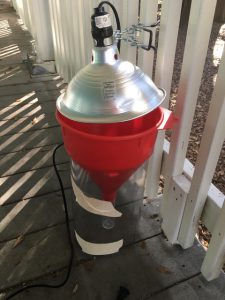
Burlese Funnel
Now we are going to do a little experiment to see what is on the Ovenbird’s Menu here in the Learning Gate forest. Each team is going to use a Berlese funnel and a quadrat to go outside to collect leaf litter from the forest. Direct the students to fill their funnel with leaf litter, cover up the bottom then bring it inside. The quadrat is a tool scientists use to standardize the size of their sample for plants or, in this case, leaf litter.
Outside:
Walk them outside into the forest and have the teams spread out. Each team will toss their quadrat and collect the leaf litter.
Classroom:
When they bring them back inside, they need to set up their funnel on the clear plastic stand with rubbing alcohol in the clear plastic vial below. Then they need to position the shop light directly over the funnel.
Background Information:
All About Birds Website:
Insect Identification Websites:
https://bugguide.net/node/view/15740
Equipment Websites:
Digital Microscope + wifi adapter https://www.dinolite.us/products/digital- microscopes/usb
Field Microscopes https://www.magiscope.com/
Berlese Funnels & How to Use Them:
https://www.carolina.com/insect-traps/berlese- funnel/654148.pr
Session #2:
After a few days, students will use a coffee filter to pour the alcohol through to collect their insects. Have the students then use the microscope and iPads to photograph whatever they found. Then use the insect field guides and “What’s that bug?” app on- line to identify what they found.
Have the students use a table to list the species, number and totals of all the insects/organisms that they found.
Conclusions:
Have each group share what they found including some of the photos that they took. Ask them which organisms they thought the Ovenbirds that winter at Learning Gate eat.
Assessment:
Ask the students to quantify how many different species of insects they found in their samples and the total number of insects they found.
Download the full lesson plan in PDF format